Bollywood
Nana Patekar Biography: Age, Family, Movies, Awards, Death and Legacy

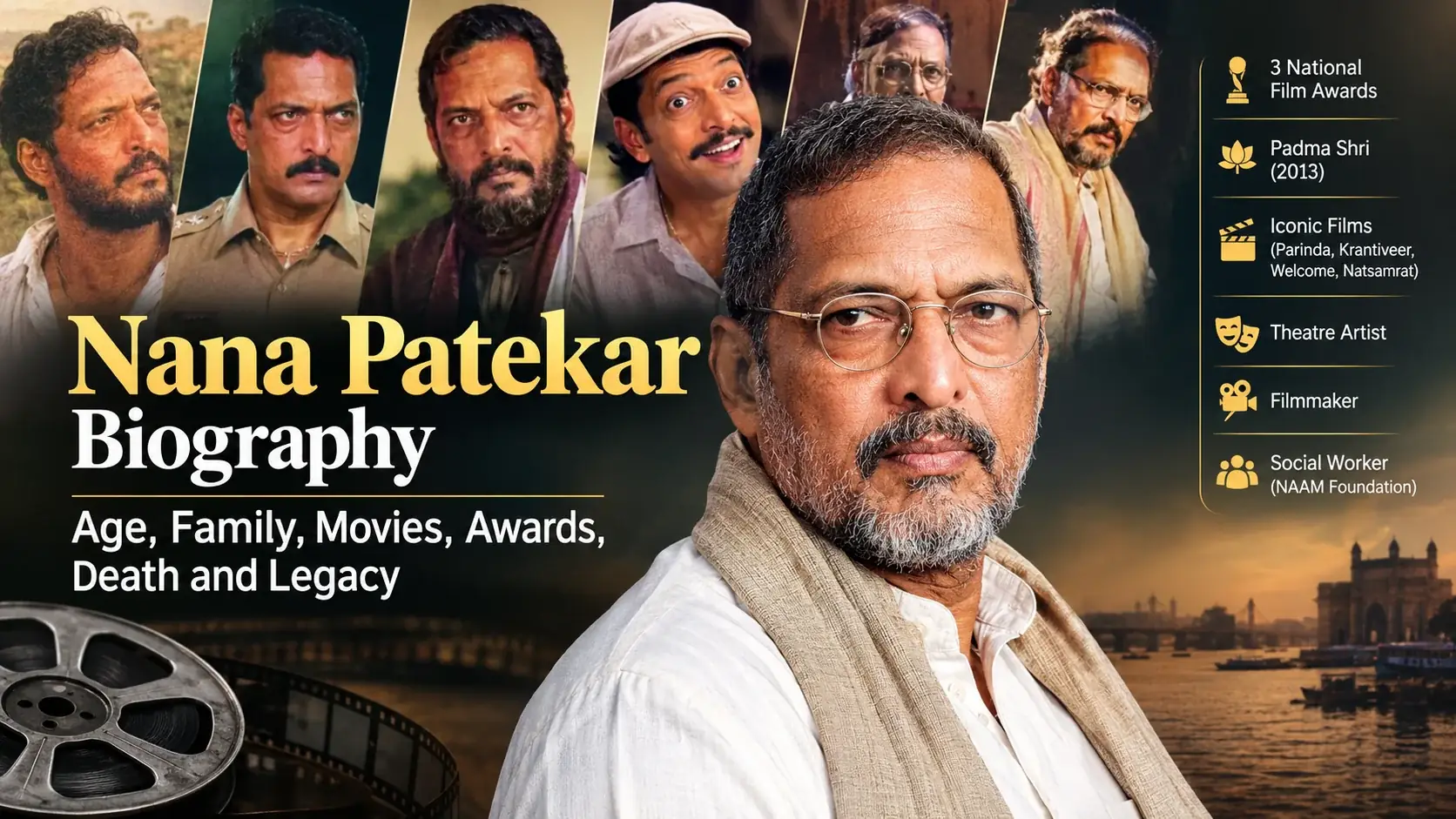
Nana Patekar was one of the most distinctive actors in Indian cinema, known for his intense performances, powerful dialogue delivery and ability to move between serious drama, action, comedy and Marathi theatre.
Born Vishwanath Patekar on January 1, 1951, in Maharashtra, he began his career in theatre before establishing himself in Hindi and Marathi cinema. Over nearly five decades, he became known for films such as Parinda, Krantiveer, Agni Sakshi, Ab Tak Chhappan, Welcome and Natsamrat.
Nana Patekar died on October 8, 2026, at the age of 75. He was found unconscious at his home in Goa and taken to Manipal Hospital, where doctors were unable to revive him. Manipal Hospital reported cardiac arrest as the cause of death; the specific trigger was not immediately known. (Reuters)
Patekar’s career included three National Film Awards, several Filmfare and regional honours, and the Padma Shri, which the Government of India awarded him in 2013 for his contribution to the arts. (Padma Awards)
Beyond acting, he worked as a filmmaker and was closely associated with the NAAM Foundation, a movement focused on helping farmers and rural communities, particularly in Maharashtra. The foundation says it was spearheaded by Nana Patekar and actor Makarand Anaspure in September 2015. (Naam Foundation)
Last updated: October 8, 2026
Nana Patekar Biography: Quick Facts
| Detail | Information |
|---|---|
| Full name | Vishwanath Patekar |
| Popular name | Nana Patekar |
| Date of birth | January 1, 1951 |
| Place of birth | Murud, Maharashtra |
| Age at death | 75 |
| Date of death | October 8, 2026 |
| Place of death | Goa |
| Reported cause of death | Cardiac arrest |
| Profession | Actor, filmmaker, theatre artist |
| Film debut | Gaman (1978) |
| Directorial debut | Prahaar: The Final Attack (1991) |
| National Film Awards | 3 |
| Padma Shri | 2013 |
| Son | Malhar Patekar |
| Known for | Parinda, Krantiveer, Ab Tak Chhappan, Welcome, Natsamrat |
| Social initiative | NAAM Foundation |
Nana Patekar Death: What Happened?
Nana Patekar died on October 8, 2026, aged 75.
According to Reuters, Patekar was found unconscious at his home in Goa early Thursday morning and was taken to Manipal Hospital. Doctors were unable to revive him. A doctor at the hospital told ANI that he died of cardiac arrest, although what triggered the cardiac arrest was not known. (Reuters)
The news brought an end to a career that had lasted almost five decades and included theatre, parallel cinema, mainstream Bollywood, Marathi cinema and filmmaking.
Did Nana Patekar die of a heart attack?
The confirmed wording available in current reporting is cardiac arrest. It is therefore more accurate to say that Manipal Hospital reported cardiac arrest as the cause of death rather than describing it as a confirmed heart attack.
That distinction matters because cardiac arrest and heart attack are not interchangeable medical terms.
Who Was Nana Patekar?
Nana Patekar was an Indian actor, filmmaker and theatre artist whose performances were often characterised by emotional intensity, forceful dialogue and unconventional characterisation.
He did not follow the conventional image of a Bollywood leading man. Instead, he built his reputation by playing characters who were frequently complicated, aggressive, vulnerable, morally ambiguous or socially frustrated.
His filmography eventually covered a remarkably broad range of roles.
He could play:
- a troubled protagonist,
- a police officer,
- a gangster,
- a military character,
- a political strategist,
- a comic gangster,
- a family man,
- or an ageing theatre actor.
That versatility became one of the defining characteristics of his career.
Reuters described him as an actor known for his intense screen presence and powerful dialogue delivery. (Reuters)
Nana Patekar Early Life and Education
Nana Patekar was born Vishwanath Patekar on January 1, 1951, in Murud, Maharashtra.
He studied at the Sir Jamsetjee Jeejebhoy School of Art in Mumbai.
His artistic training and early association with theatre played an important role in shaping the performer he eventually became. Rather than entering mainstream Hindi cinema immediately as a conventional star, Patekar developed his craft through theatre and serious acting.
That background later became especially important in films where dialogue, psychological depth and emotional control were central to the performance.
When Did Nana Patekar Start Acting?
Nana Patekar’s film career began with Gaman in 1978.
The film is generally identified as his film debut, marking the beginning of a screen career that would eventually span Hindi, Marathi and other Indian-language cinema.
His early work was followed by roles in films associated with India’s parallel and arthouse cinema before he gained wider recognition through major commercial and critically acclaimed productions.
Reuters notes that Patekar began his career in Marathi theatre before moving into arthouse cinema and eventually mainstream Bollywood. (Reuters)
Nana Patekar Movies: His Most Important Films
Nana Patekar appeared in a wide range of films during his career. Some were critically acclaimed dramas, while others became mainstream commercial successes.
Here are some of the films most important to understanding his career.
1. Gaman (1978)
Gaman marked Nana Patekar’s film debut.
The film belongs to the period of Hindi cinema in which socially grounded and realistic stories were receiving significant attention.
For Patekar, it was the beginning of a screen career that would eventually make him one of India’s best-known character actors.
2. Parinda (1989)
Parinda was a major turning point in Nana Patekar’s career.
His performance earned him the National Film Award for Best Supporting Actor, establishing him as a performer capable of bringing considerable psychological intensity to crime dramas.
The film also became an important milestone in his rise to national recognition.
Patekar later recalled suffering a serious burn while working on Parinda and being unable to work for an extended period. That detail should be understood as his recollection of the experience rather than as an independently verified account of every production circumstance.
3. Prahaar: The Final Attack (1991)
Prahaar: The Final Attack occupies a special place in Nana Patekar’s career because it marked his directorial debut.
The film also reflected his interest in military themes, discipline and the psychological impact of violence.
It demonstrated that Patekar’s ambitions extended beyond acting.
4. Krantiveer (1994)
Krantiveer became one of the defining performances of Nana Patekar’s career.
He played Pratap Narayan Tilak, a troubled man who becomes an outspoken figure challenging social and political injustice.
The performance earned him the National Film Award for Best Actor.
It also won him the Filmfare Award for Best Actor.
For many viewers, Krantiveer remains one of the clearest examples of Patekar’s ability to combine anger, vulnerability and powerful dialogue delivery.
5. Agni Sakshi (1996)
In Agni Sakshi, Patekar delivered another acclaimed supporting performance.
The role earned him his third National Film Award, this time for Best Supporting Actor.
His National Film Award-winning performances therefore covered both leading and supporting roles, demonstrating the breadth of his acting career.
6. Khamoshi: The Musical (1996)
Khamoshi: The Musical, directed by Sanjay Leela Bhansali, showcased Patekar in a more emotionally restrained family drama.
The performance demonstrated another side of his acting beyond the aggressive characters for which he was increasingly famous.
7. Ab Tak Chhappan (2004)
Ab Tak Chhappan became one of Nana Patekar’s most memorable crime films.
He played police inspector Sadhu Agashe, a character whose professionalism, emotional restraint and moral ambiguity drive the story.
The role reinforced his reputation for playing tough characters without turning them into conventional action heroes.
8. Welcome (2007)
For an entire generation of mainstream Hindi-film audiences, Nana Patekar became especially famous for playing Uday Shetty in Welcome.
The character was a gangster who wanted to move away from crime and establish a respectable life, creating much of the film’s comic conflict.
Patekar’s performance demonstrated his exceptional comic timing.
The role was particularly effective because he retained the intensity associated with his dramatic performances while adapting it to comedy.
His scenes with Anil Kapoor’s Majnu Bhai became among the most memorable elements of the film.
9. Raajneeti (2010)
In Prakash Jha’s political drama Raajneeti, Patekar played Brij Gopal, a character involved in political strategy and power.
The film gave him another opportunity to work within a large ensemble cast and return to the serious political drama genre.
10. Natsamrat (2016)
Natsamrat is one of the most important films of Nana Patekar’s later career.
Based on the acclaimed Marathi play, the film follows an ageing theatre actor dealing with retirement, family relationships, memory and loss.
The subject had a particularly strong connection with Patekar because of his own theatre background.
The Indian Express reported that Patekar regarded Natsamrat as his dream project.
For viewers wanting to understand the connection between his theatre roots and film career, Natsamrat is essential viewing.
Nana Patekar Movies List
| Year | Film | Significance |
|---|---|---|
| 1978 | Gaman | Film debut |
| 1989 | Parinda | National Film Award-winning performance |
| 1991 | Prahaar: The Final Attack | Directorial debut |
| 1994 | Krantiveer | National Award-winning lead performance |
| 1996 | Agni Sakshi | Third National Film Award |
| 1996 | Khamoshi: The Musical | Acclaimed dramatic performance |
| 2004 | Ab Tak Chhappan | Iconic police role |
| 2007 | Welcome | Major mainstream comedy role |
| 2010 | Raajneeti | Political drama |
| 2015 | Welcome Back | Return as Uday Shetty |
| 2016 | Natsamrat | Major Marathi performance |
| 2018 | Kaala | Tamil-language film |
| 2023 | The Vaccine War | Later-career Hindi film |
| 2024 | Vanvaas | Later-career Hindi film |
| 2025 | Housefull 5 | Mainstream Hindi cinema |
Why Was Nana Patekar Famous for Welcome?
Nana Patekar’s Uday Shetty in Welcome is one of his most popular commercial-film characters.
The role allowed audiences to see a completely different side of the actor who had become famous for intense performances in films such as Krantiveer and Ab Tak Chhappan.
Uday Shetty combines gangster stereotypes with comic insecurity and an exaggerated desire for respectability.
Patekar’s delivery, timing and physical reactions turned the character into one of his most recognisable mainstream performances.
The popularity of Uday Shetty also introduced Patekar’s work to audiences who may not have been familiar with his earlier serious films.
Why Is Natsamrat Important in Nana Patekar’s Career?
Natsamrat is important because it brought together two major elements of Nana Patekar’s career: theatre and cinema.
The story centres on an ageing stage actor confronting retirement, family conflict and the loss of his professional identity.
Patekar’s theatre background gave the role added significance.
The Indian Express reported in 2015 that Patekar called Natsamrat his dream project.
For anyone exploring Nana Patekar’s acting beyond Bollywood’s commercial cinema, Natsamrat is one of the strongest starting points.
How Many National Film Awards Did Nana Patekar Win?
Nana Patekar won three National Film Awards.
| Award | Film | Year |
|---|---|---|
| Best Supporting Actor | Parinda | 1990 |
| Best Actor | Krantiveer | 1995 |
| Best Supporting Actor | Agni Sakshi | 1997 |
These awards made Patekar one of the most recognised performers of his generation.
What makes the achievement particularly notable is that his wins included both Best Actor and Best Supporting Actor categories.
Did Nana Patekar Win the Padma Shri?
Yes.
Nana Patekar received the Padma Shri in 2013 for his contribution to the arts.
The official Government of India Gazette lists Shri Nana Gajanan Patekar under Art, Maharashtra among the Padma Shri awardees. (Padma Awards)
The Government’s Press Information Bureau also records the 2013 Padma Awards and identifies the Padma Shri as one of India’s civilian honours. (Press Information Bureau)
Official source: 2013 Padma Awards – Government of India
Nana Patekar Awards and Honours
| Award | Film/achievement | Year |
|---|---|---|
| National Film Award – Best Supporting Actor | Parinda | 1990 |
| Filmfare – Best Supporting Actor | Parinda | 1990 |
| Filmfare – Best Negative Role | Angaar | 1993 |
| National Film Award – Best Actor | Krantiveer | 1995 |
| Filmfare – Best Actor | Krantiveer | 1995 |
| National Film Award – Best Supporting Actor | Agni Sakshi | 1997 |
| Filmfare – Best Negative Role | Apaharan | 2006 |
| Filmfare Marathi – Best Actor | Dr. Prakash Baba Amte: The Real Hero | 2015 |
| Zee Gaurav – Best Actor | Natsamrat | 2016 |
| Ananda Vikatan Cinema Award – Villainous Role | Kaala | 2019 |
What Made Nana Patekar’s Acting Style Unique?
Nana Patekar developed an acting style that was instantly recognisable.
His performances often combined:
- powerful dialogue delivery,
- controlled aggression,
- emotional volatility,
- expressive eyes,
- distinctive body language,
- sudden changes in vocal intensity,
- long pauses,
- and a willingness to portray morally complicated characters.
His strength was not simply his ability to deliver loud or memorable dialogues.
In many of his strongest performances, he used silence and restraint to build tension.
That helped him transition successfully between radically different films.
The same actor who could dominate a serious confrontation in Krantiveer could also play the comic Uday Shetty in Welcome and the ageing theatre artist in Natsamrat.
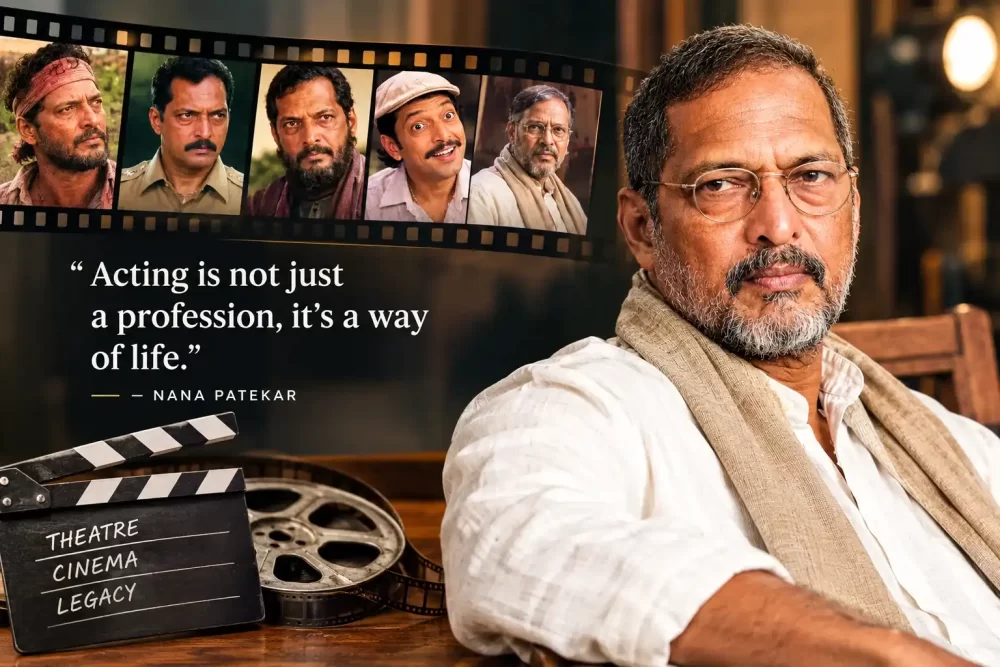
Nana Patekar built a celebrated career across Hindi and Marathi cinema, theatre and filmmaking. Nana Patekar’s distinctive acting style reflected his roots in theatre and his wide-ranging career in Indian cinema.
Was Nana Patekar Associated With the Indian Army?
Nana Patekar had a significant connection with military training and military-themed work, particularly around Prahaar: The Final Attack.
Reports following his death also described his involvement during the 1999 Kargil War, including claims that he sought permission to serve and received military training.
However, it is important not to oversimplify this part of his biography by describing him as a conventional long-term Indian Army officer.
His military association is better described as reported service/training connected with the Army and the Kargil period, rather than as a conventional military career.
That distinction helps avoid one of the common inaccuracies found in online biographies of Patekar.
Who Were Nana Patekar’s Wife and Son?
Nana Patekar married Neelakanti Patekar in 1978, and they had a son, Malhar Patekar.
Reuters reported after his death that Patekar was survived by his estranged wife and son. (Reuters)
For accuracy, it is preferable to use the terms estranged or separated rather than stating that the couple were divorced unless a reliable source specifically establishes that.
What Was Nana Patekar’s Role in NAAM Foundation?
Nana Patekar was also known for his social work.
The NAAM Foundation was spearheaded by Nana Patekar and actor Makarand Anaspure in September 2015, according to the organisation’s official website. Its work developed in response to drought conditions and the hardships faced by farmers in Maharashtra. (Naam Foundation)
The foundation says its work includes:
- helping farming communities,
- supporting village development,
- educating farmers,
- improving water management,
- reviving canals,
- restoring abandoned water projects,
- and addressing rural hardship.
NAAM Foundation’s official trustee page currently identifies Nana Patekar as Chairman and Makarand Anaspure as Secretary. (Naam Foundation)
Official website: NAAM Foundation
This part of Patekar’s public life is important because his legacy extended beyond acting and filmmaking.
Nana Patekar Career Timeline
| Year | Career milestone |
|---|---|
| 1951 | Born in Murud, Maharashtra |
| 1978 | Film debut with Gaman |
| 1989 | Major recognition with Parinda |
| 1990 | First National Film Award |
| 1991 | Directorial debut with Prahaar |
| 1994–95 | Krantiveer and National Award for Best Actor |
| 1996–97 | Agni Sakshi and third National Film Award |
| 2004 | Ab Tak Chhappan |
| 2007 | Welcome and Uday Shetty |
| 2010 | Raajneeti |
| 2013 | Padma Shri |
| 2015 | NAAM Foundation association; Welcome Back |
| 2016 | Natsamrat |
| 2018 | Kaala |
| 2026 | Died at age 75 |
Why Was Nana Patekar Different From Other Bollywood Actors?
Nana Patekar’s career crossed several boundaries.
Theatre actor
His theatre background gave him a strong command of dialogue, voice and physical performance.
Serious film actor
Parinda, Krantiveer and Agni Sakshi established him as a major dramatic performer.
Mainstream entertainer
Welcome demonstrated his ability to dominate a commercial comedy.
Filmmaker
He directed Prahaar: The Final Attack.
Marathi cinema performer
Natsamrat became one of his most important later performances.
Social worker
His association with NAAM Foundation gave his public life a significant social dimension.
This combination of theatre, serious cinema, mainstream entertainment, filmmaking and social work made Patekar difficult to categorise simply as a “Bollywood actor.”
Which Nana Patekar Movies Should You Watch First?
If you have never watched Nana Patekar’s work, this shortlist offers a good introduction.
For serious acting: Parinda
A major early performance and his first National Film Award-winning role.
For powerful dialogue: Krantiveer
One of the clearest examples of his intense screen presence.
For crime drama: Ab Tak Chhappan
A restrained and morally complicated police performance.
For comedy: Welcome
The best starting point for viewers who want to see his comic side.
For Marathi cinema: Natsamrat
Especially valuable for understanding his connection with theatre.
For filmmaking: Prahaar: The Final Attack
His directorial debut.
For political drama: Raajneeti
A strong example of his later Hindi-film work.
Nana Patekar’s Legacy in Indian Cinema
Nana Patekar leaves behind a body of work that crosses the boundaries between mainstream Bollywood and serious Indian cinema.
His career began with theatre and developed through films that demanded strong characterisation. He later became equally recognisable for dramatic roles and comedy.
Few Indian actors successfully moved between films such as Krantiveer, Ab Tak Chhappan, Welcome and Natsamrat while retaining such a distinctive screen identity.
His three National Film Awards and Padma Shri reflect the critical and institutional recognition he received, while characters such as Uday Shetty demonstrate his enduring popularity with mainstream audiences.
His work with NAAM Foundation added another dimension to his public legacy.
Following his death on October 8, 2026, tributes from the film industry highlighted his individuality, intensity and contribution to Indian cinema. Reuters reported tributes describing his unusual talent and authenticity. (Reuters)
Frequently Asked Questions About Nana Patekar
What was Nana Patekar’s real name?
Nana Patekar’s birth name was Vishwanath Patekar.
When was Nana Patekar born?
Nana Patekar was born on January 1, 1951, in Murud, Maharashtra.
How old was Nana Patekar when he died?
Nana Patekar was 75 years old when he died on October 8, 2026. (Reuters)
When did Nana Patekar die?
Nana Patekar died on October 8, 2026, in Goa. (Reuters)
What was Nana Patekar’s cause of death?
Manipal Hospital reported cardiac arrest as the cause of death. The specific trigger was not immediately known. (Reuters)
What was Nana Patekar’s first movie?
Nana Patekar made his film debut in Gaman (1978).
How many National Film Awards did Nana Patekar win?
He won three National Film Awards, for Parinda, Krantiveer and Agni Sakshi.
Did Nana Patekar win the Padma Shri?
Yes. He received the Padma Shri in 2013 for Art, Maharashtra. (Padma Awards)
What is Nana Patekar’s most famous comedy role?
His portrayal of Uday Shetty in Welcome is among his best-known comedy performances.
What is Nana Patekar’s most important Marathi film?
Natsamrat (2016) is widely regarded as one of his most important later Marathi performances, particularly because of its connection to his theatre background.
Was Nana Patekar a filmmaker?
Yes. He made his directorial debut with Prahaar: The Final Attack (1991).
What was Nana Patekar’s connection with NAAM Foundation?
Nana Patekar was one of the key figures behind NAAM Foundation, which focuses on supporting farmers and rural communities, particularly in Maharashtra. (Naam Foundation)
Conclusion
Nana Patekar’s journey from Marathi theatre to some of the most memorable performances in Hindi and Marathi cinema made him one of India’s most distinctive actors.
From Gaman and Parinda to Krantiveer, Ab Tak Chhappan, Welcome and Natsamrat, his career demonstrated a rare ability to combine intensity, vulnerability, humour and realism.
His three National Film Awards and Padma Shri recognised his contribution to Indian cinema and the arts, while his work with NAAM Foundation added an important social dimension to his public life. (Padma Awards)
Nana Patekar died on October 8, 2026, aged 75. His films, theatre background, memorable characters and unmistakable acting style ensure that his contribution will remain an important part of Indian cinema’s history. (Reuters)