Africa
Rwanda Women Leaders: How Women Are Shaping the Country

Published
8 hours agoon
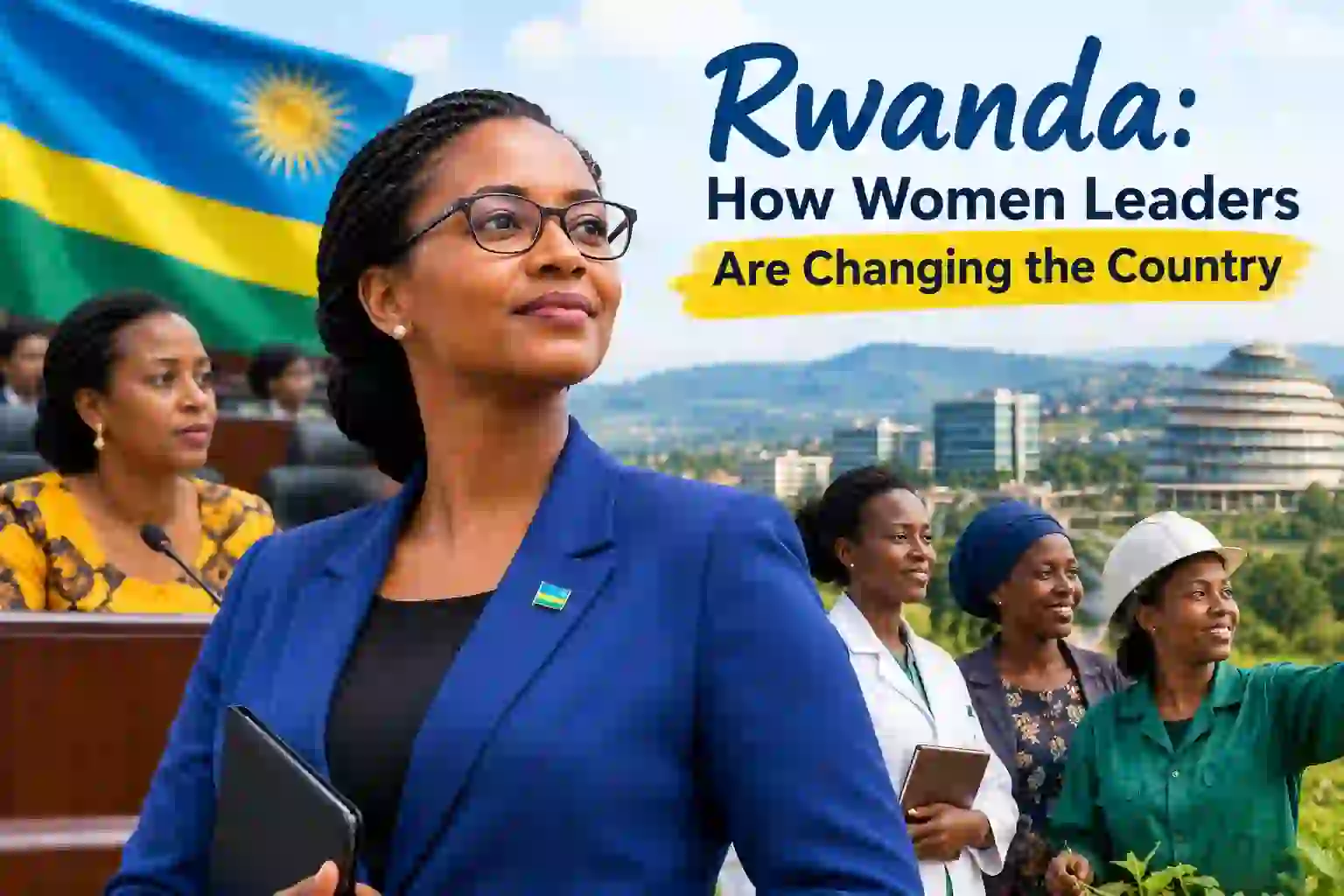
Table of Contents
ToggleRwanda women leaders have become a defining feature of the country’s political and public institutions. Women now hold a majority of seats in Rwanda’s Chamber of Deputies and occupy senior positions in Parliament, government ministries, technology, public administration, agriculture and community organisations.
Following the 1994 Genocide against the Tutsi, Rwanda undertook a broad process of institutional and social reconstruction. Women’s participation in that process became increasingly formalised through constitutional and electoral reforms.
Today, Rwanda has the highest proportion of women in a national parliament in the world. In the current 2024-2029 legislature, women hold 63.75% of seats in the 80-member Chamber of Deputies. The country’s 26-member Senate is also majority female, with women accounting for 53.8% of senators according to UN Women’s 2026 Rwanda strategic note.
But the significance of Rwanda’s women leaders goes beyond parliamentary statistics.
Women are represented across political institutions and public administration, while women-led initiatives have also played roles in agriculture, technology, community development and gender-policy implementation.
At the same time, Rwanda continues to face challenges involving women’s economic participation, unpaid care work and gender-based violence. High political representation therefore does not, by itself, mean that all gender inequalities have been resolved.
Rwanda Women Leaders: Key Facts
| Issue | Current picture |
|---|---|
| Women in Chamber of Deputies | 63.75% |
| Chamber of Deputies | 80 members |
| Women in Senate | 53.8% |
| Current Chamber of Deputies Speaker | Gertrude Kazarwa |
| Current legislature | 2024–2029 |
| Constitutional minimum for women in decision-making organs | 30% |
| Women in Parliament in 2008 | 56.3% |
| Women in Parliament in 1994 | 4.3% |
Sources: Rwanda Parliament, IPU Parline and UN Women.
From Post-Genocide Reconstruction to Women’s Political Leadership
The growth of women’s political representation in Rwanda is closely connected to the country’s post-1994 reconstruction and institutional reforms.
The 2003 Constitution, subsequently revised in 2015, established a minimum requirement of 30% women’s representation in decision-making organs. Rwanda’s Parliament also states that at least 30% of members of the Chamber of Deputies must be women.
The constitutional framework was accompanied by electoral mechanisms that included reserved seats for women.
The Chamber of Deputies currently has 24 seats elected through women’s electoral colleges, alongside 53 seats elected through proportional representation, two youth representatives and one representative of persons with disabilities.
The result has been a dramatic increase in women’s representation.
According to the Inter-Parliamentary Union (IPU), women represented:
- 4.3% of Rwanda’s parliamentary seats in 1994
- 48.8% in 2003
- 56.3% in 2008
- 63.8% in 2013
- 61.3% in 2018
- 63.8% following the 2024 parliamentary election data recorded by IPU
The 2024 figure is also reflected by Rwanda’s Parliament, which currently reports 63.75% women in the Chamber of Deputies.
The 2008 election was a major milestone. IPU records that 45 women entered the 80-member Chamber of Deputies, giving women 56.25% of the chamber and making Rwanda the first country to elect more women than men to its lower house.
This long-term trajectory helps explain why Rwanda is now frequently cited in international discussions about women’s political representation.
Rwanda Parliament – Chamber of Deputies
Gertrude Kazarwa: Leading Rwanda’s Chamber of Deputies
Gertrude Kazarwa is the current Speaker of Rwanda’s Chamber of Deputies.
She was elected Speaker on August 14, 2024, at the beginning of the current fifth legislature, which runs from 2024 to 2029.
Before becoming Speaker, Kazarwa served as a senator from 2014 to 2019 and was Deputy Chairperson of the Senate Standing Committee on Political Affairs and Good Governance.
She later founded and managed Bright Stars Foundation Academy, before becoming Speaker of the Chamber of Deputies in 2024. Rwanda’s Parliament lists her educational background as including an MBA in Finance and Administration, a law degree and a degree in management.
Her position places a woman at the head of a parliamentary chamber in which women hold nearly two-thirds of the seats.
Gertrude Kazarwa – Rwanda Parliament profile
Paula Ingabire: Women and Rwanda’s Technology Agenda
Women’s leadership in Rwanda extends beyond Parliament.
Paula Ingabire is Rwanda’s current Minister of ICT and Innovation. The ministry’s official profile says Ingabire previously headed the ICT Business Development Department at the Rwanda Development Board and coordinated the Kigali Innovation City project.
The Ministry of ICT and Innovation is responsible for national policies and programmes involving information technology, communications, innovation and citizen empowerment.
Ingabire’s portfolio places her at the intersection of technology policy, digital services and Rwanda’s efforts to expand its digital economy.
Technology has also provided an example of how women’s leadership can connect national policy with rural economic activity.
In 2021, Rwanda’s Ministry of ICT and Innovation reported that 3,000 female leaders of farming cooperatives received smartphones through the Connect Rwanda initiative. The programme aimed to help cooperative leaders access agricultural information and communicate it to farmers in their communities.
The example is significant because it shows that women’s leadership in Rwanda is not confined to national political institutions. It can also operate through agriculture, cooperatives and technology-enabled community networks.
Rwanda Ministry of ICT and Innovation
Judith Uwizeye: Women in Public Service Leadership
Judith Uwizeye is another current example of women’s leadership in Rwanda’s executive government.
She was appointed Minister of Public Service and Labour on June 10, 2026, according to the ministry’s official profile. She previously held the same portfolio from 2014 to 2017 and subsequently served as Minister in the Office of the President.
The Ministry of Public Service and Labour is responsible for policies and programmes involving public service management, labour, employment, institutional capacity and public-sector human resources.
Following her appointment in June 2026, Uwizeye said her priorities included continuing public-sector reforms, improving service delivery, supporting job creation and developing citizen-focused programmes.
Her current role illustrates another dimension of women’s participation in Rwanda’s leadership structure: public administration and labour policy.
Rwanda Ministry of Public Service and Labour
Donatille Mukabalisa and a Previous Generation of Women Leaders
The current generation of Rwanda women leaders follows earlier women who held senior positions in national institutions.
Donatille Mukabalisa served as Speaker of the Chamber of Deputies from October 2013 until August 2024. She was succeeded by Gertrude Kazarwa. IPU records the transition from Mukabalisa to Kazarwa in August 2024.
Mukabalisa remains a member of Rwanda’s Senate in the current legislature, according to Parliament’s member profile.
During her tenure as Speaker, Mukabalisa participated in parliamentary diplomacy, legislative activities and discussions around Rwanda’s gender-equality policies.
The transition from Mukabalisa to Kazarwa demonstrates continuity in women’s leadership of Rwanda’s lower parliamentary chamber.
Rwanda Parliament – Donatille Mukabalisa profile
Women Are Leading Beyond Rwanda’s Parliament
Political representation is only one part of the broader story.
Rwanda’s government and international organisations working in the country identify women’s participation across multiple areas, including:
- Local government
- Agriculture
- Cooperatives
- Technology
- Public administration
- Entrepreneurship
- Education
- Community development
- Civil society
- Gender-policy implementation
Rwanda’s Ministry of Gender and Family Promotion says women participate in leadership positions from local to national levels and identifies women’s participation in reconstruction, peacebuilding and community-level institutions as part of the country’s gender-equality framework.
Women also play an important role in agriculture.
For more context on women’s participation in agriculture, see NewsViewsNetwork’s related article on women in the agricultural labour force.
The Connect Rwanda initiative provides one concrete example of this intersection between women, agriculture and technology. In 2021, 3,000 female cooperative leaders received smartphones to help them access and distribute agricultural information.
How Women’s Political Representation Has Affected Policy
Rwanda’s large number of women parliamentarians has also coincided with the development of legislation and institutions addressing gender equality.
The Inter-Parliamentary Union says Rwanda’s women parliamentarians have contributed to the country’s legal and policy framework on gender equality, including legislation concerning gender-based violence, inheritance, labour, nationality and citizenship, reproductive healthcare and gender-responsive budgeting.
UN Women has similarly documented work involving women’s political participation, economic opportunity and efforts to address gender-based violence.
This does not mean that every policy outcome can be attributed solely to women parliamentarians. Rwanda’s political institutions involve multiple actors, including political organisations, government ministries, civil society and community institutions.
The more defensible conclusion is that the presence of large numbers of women in decision-making institutions has created a substantial formal channel through which women can participate in legislation, oversight and policy discussions.
Is Rwanda’s 30% Women’s Quota the Reason for Its High Representation?
The constitutional quota is an important part of the explanation, but it does not fully explain Rwanda’s current numbers.
Rwanda’s Constitution provides for women to occupy at least 30% of positions in decision-making organs. The Chamber of Deputies also includes 24 seats specifically elected through women’s electoral colleges.
However, women have also won seats beyond the reserved category.
For example, in the 2013 election, IPU recorded 51 women among the 80 members of the Chamber of Deputies, including women elected through general seats as well as reserved seats.
Similarly, the 2008 election returned 45 women to the Chamber, including women elected through both direct and indirect mechanisms.
Therefore, the quota provides a constitutional floor rather than explaining the entire level of women’s representation.
Rwanda Women Leaders and the Gender Equality Challenge
Rwanda’s parliamentary figures are striking, but representation should not be confused with complete gender equality.
UN Women identifies continuing challenges involving women’s economic participation, unemployment, informal employment and unpaid care work.
Unpaid care work is one example.
UN Women reported in 2024 that women in Rwanda spent an average of 7.1 hours per day on unpaid care work, compared with 2.1 hours for men. The organisation has worked with Rwanda’s Ministry of Gender and Family Promotion on initiatives aimed at recognising, reducing and redistributing unpaid care responsibilities.
Gender-based violence is another continuing issue.
UN Women says gender-based violence remains a significant concern in Rwanda despite legislative and institutional progress. Its work includes support for prevention, institutional capacity and survivor-centred services.
Rwanda therefore presents two realities at once:
Women have exceptionally high political representation, while broader social and economic gender inequalities remain.
That distinction is important when assessing Rwanda’s experience.
UN Women – Rwanda country data
Is Rwanda a Model for Women’s Political Representation?
Rwanda is frequently cited internationally because of its unusually high level of women’s representation in Parliament.
The IPU’s historical data shows the scale of the change: women’s representation increased from 4.3% in 1994 to 56.3% in 2008 and 63.8% in the 2024 election cycle.
Rwanda’s own gender institutions also describe the country as having the world’s highest level of women’s representation in Parliament.
However, describing Rwanda as a “model” depends on what is being measured.
If the measure is women’s representation in national Parliament, Rwanda is an exceptional case.
If the measure is broader gender equality, the picture is more complicated because economic participation, unpaid care work and gender-based violence remain areas of concern.
This distinction makes the Rwandan experience more useful to understand: political representation is one measurable outcome of gender policy and institutional design, but it is not the same thing as equality across every area of society.
What Rwanda’s Women Leaders Show About Political Representation
Rwanda’s experience demonstrates how constitutional rules, electoral mechanisms and institutional reforms can produce a substantial increase in women’s representation in political institutions.
The transformation is particularly visible when comparing the post-1994 period with the current Parliament.
Women accounted for only 4.3% of parliamentary seats in 1994. By 2008, they held 56.3%, and the current Chamber of Deputies has a women’s share of 63.75%.
The leadership of Gertrude Kazarwa, the ministerial roles held by Paula Ingabire and Judith Uwizeye, and the earlier speakership of Donatille Mukabalisa illustrate how women’s participation extends across Parliament and the executive branch.
At the community level, initiatives involving women farmers and cooperatives provide another example of how women participate in economic and technology-related programmes.
At the same time, Rwanda’s experience also shows why representation and gender equality should not be treated as identical concepts.
High numbers of women in Parliament coexist with continuing challenges involving unpaid care work, economic participation and gender-based violence.
Frequently Asked Questions About Rwanda Women Leaders
Why does Rwanda have so many women in Parliament?
Rwanda’s high level of women’s parliamentary representation is linked to constitutional provisions requiring at least 30% women’s representation in decision-making organs, reserved seats for women and women’s participation in general electoral contests. Women have subsequently won representation well above the constitutional minimum.
What percentage of Rwanda’s Parliament is made up of women?
Women currently hold 63.75% of seats in Rwanda’s Chamber of Deputies. UN Women’s 2026 Rwanda strategic note reports women holding 53.8% of Senate seats.
Who is the current Speaker of Rwanda’s Chamber of Deputies?
Gertrude Kazarwa has been Speaker of the Chamber of Deputies since August 14, 2024.
Who is Rwanda’s Minister of ICT and Innovation?
Paula Ingabire is Rwanda’s Minister of ICT and Innovation. The ministry says she previously led its ICT Business Development Department and coordinated the Kigali Innovation City project at the Rwanda Development Board.
Who is Rwanda’s Minister of Public Service and Labour?
Judith Uwizeye was appointed Minister of Public Service and Labour on June 10, 2026. She previously held the same ministerial portfolio from 2014 to 2017.
Who was Rwanda’s previous female Speaker?
Donatille Mukabalisa served as Speaker of the Chamber of Deputies from October 2013 until August 2024. She is currently a senator.
Did Rwanda have a female-majority Parliament before 2024?
Yes. Rwanda’s Chamber of Deputies first became majority female after the 2008 election, when women won 45 of 80 seats, or 56.25%.
Does Rwanda’s high number of women MPs mean gender equality has been achieved?
No. Political representation is one measure of gender equality, but UN Women continues to identify challenges involving economic participation, unpaid care work and gender-based violence in Rwanda.
Conclusion: Rwanda’s Women Leaders and the Road Ahead
Rwanda women leaders have become an important part of the country’s political and institutional landscape.
The transformation is measurable. Women now occupy 63.75% of seats in the Chamber of Deputies, while women also hold a majority of Senate seats according to UN Women’s latest Rwanda strategic data.
The rise did not happen overnight. It followed the post-1994 reconstruction period, constitutional reforms, electoral mechanisms and the growing participation of women in political institutions.
Leaders such as Gertrude Kazarwa, Paula Ingabire, Judith Uwizeye and Donatille Mukabalisa illustrate different dimensions of women’s leadership in Rwanda, from parliamentary governance to technology, public administration and institutional development.
But Rwanda’s experience also offers an important qualification: having more women in political office does not automatically eliminate wider gender inequalities.
The country’s continuing challenges around unpaid care work, economic participation and gender-based violence show that representation is one part of the gender-equality equation.
Rwanda’s story is therefore not simply about how many women occupy political seats. It is about how women have become increasingly visible across the country’s governance and development institutions – and about the remaining work required to translate political representation into broader equality and opportunity.
Primary sources
- Rwanda Parliament
- Rwanda Parliament – Chamber of Deputies
- Rwanda Ministry of ICT and Innovation
- Rwanda Ministry of Public Service and Labour
- Rwanda Ministry of Gender and Family Promotion
- Inter-Parliamentary Union – Rwanda parliamentary data
- UN Women – Rwanda Country Data
- UN Women – Rwanda Strategic Note 2026–2029
- Women in agricultural labour force

Sushree Mishra is a content and social media professional with a keen interest in digital media, technology, business, and current affairs. She focuses on creating engaging, informative content that connects ideas with readers. Her work reflects a passion for clear storytelling, digital communication, and emerging trends shaping the modern world.

You may like
-

Women make up 43% of the agricultural labour force in the developing world
-

Wonderla Park Closure due to Covid-19 Second Wave- Effective from 19th April
-

Amrita Vishwa Vidyapeetham’s Women Exclusive Cybersecurity Conference ShaktiCon to begin April 9, 2021
-

What Women Really Want on Women’s Day
-


Wonderla’s Women’s Day initiative wins hearts
-


GreyCampus announces 100 scholarships for women to take up Career Programs in Data Science and Full Stack Development