Cars
Why Asian Car Brands Are Gaining Ground in the U.S. Auto Market


Asian car brands in US markets have become increasingly influential, with Japanese automakers such as Toyota and Honda and South Korean brands such as Hyundai and Kia competing strongly across hybrids, SUVs and other popular vehicle segments. Their focus on reliability, fuel efficiency, technology and U.S. manufacturing is reshaping competition in the American auto industry.
Asian car brands in the US are gaining ground because they offer a competitive combination of fuel efficiency, hybrid technology, SUVs, modern features and long-established customer trust. Toyota, Honda, Hyundai, Kia, Subaru, Nissan and Mazda have built substantial American businesses, and their vehicles now compete across nearly every major passenger-car segment.
The shift has become particularly visible in 2026. In its September 24 market forecast, Cox Automotive projected that Asian brands would account for more than half of U.S. new-vehicle sales for a second consecutive quarter. The same forecast expected the traditional Detroit Three – General Motors, Ford and Stellantis – to fall to just over 36% of the market, their lowest combined share on record.
These figures are forecasts, not final sales results. However, they highlight a broader change in the competitive landscape.
American buyers are not abandoning domestic automakers. Rather, they have more reasons to consider Japanese and South Korean vehicles when comparing fuel economy, purchase prices, long-term ownership costs, safety technology and available powertrains.
Understanding this shift requires looking beyond brand popularity. Decades of investment, changing consumer preferences, expanding U.S. manufacturing and a strong selection of hybrids and crossovers have all helped Asian automakers strengthen their position.
Why Are Asian Car Brands in the US Becoming More Popular?
Asian automakers are gaining market share because many have aligned their products with what a significant portion of American buyers want: practical vehicles that balance efficiency, comfort, technology and ownership costs.
Several factors explain their momentum:
- Hybrid expertise: Toyota and Honda have established hybrid lineups, while Hyundai and Kia offer competing hybrid options.
- A broad SUV selection: Japanese and South Korean brands compete in compact, midsize and three-row SUV categories.
- Long-standing brand recognition: Many American consumers are familiar with these manufacturers and their vehicles.
- Competitive features: Infotainment systems, smartphone connectivity and driver-assistance technology are increasingly common across their lineups.
- U.S. manufacturing: Several Asian automakers assemble vehicles in America, supporting local employment and helping them serve the market.
- More choices across price points: Buyers can compare economy cars, family sedans, hybrids, electric vehicles, crossovers and pickup trucks.
The important point is that Asian automakers no longer compete only on the promise of inexpensive transportation. They compete on the overall ownership proposition, from the showroom to the years a vehicle spends on the road.
1. Hybrid Vehicles Give Asian Automakers a Competitive Advantage
Hybrid technology is one of the clearest reasons Asian manufacturers remain competitive in the American market.
A conventional hybrid combines a gasoline engine with an electric motor and battery. It can recover energy during braking and use electric power to assist the engine, often improving fuel economy compared with a similar gasoline-only vehicle.
Unlike a battery-electric vehicle, a conventional hybrid generally does not need to be plugged in. That makes it attractive to drivers who want to reduce fuel consumption but do not want to plan around charging stations.
Toyota helped establish hybrids as a mainstream choice in the United States, while Honda, Hyundai and Kia have developed their own offerings. Their portfolios give consumers alternatives across sedans, compact crossovers and larger family vehicles.
Why do hybrids appeal to American drivers?
For many households, the decision is practical rather than ideological. A hybrid can reduce trips to the gas station without requiring changes to everyday driving habits.
Consider a commuter who drives long distances during the week and occasionally takes family road trips. A hybrid SUV may offer lower fuel consumption than a comparable gasoline model while retaining the familiar refueling experience.
Hybrids also provide a different ownership proposition from fully electric vehicles. Drivers do not need a home charger to use a conventional hybrid, and long-distance travel does not depend on public charging infrastructure.
However, a hybrid is not automatically the cheapest option. Buyers should compare its purchase price, fuel savings, insurance, maintenance and expected annual mileage. A higher upfront cost may take years to recover through reduced fuel spending.
Cox Automotive specifically identified consumer movement toward hybrid vehicles as one factor behind the market-share gains of Asian brands in its 2026 forecast.
2. Toyota’s Long-Term Strategy Is Paying Off
Toyota’s U.S. presence is the result of decades of investment in manufacturing, dealerships, product development and customer relationships.
The company has built a broad lineup that includes sedans, compact and three-row SUVs, pickup trucks, hybrids and other electrified vehicles. This range allows it to serve buyers with different budgets and driving needs rather than relying on a single successful category.
Toyota’s hybrid strategy is particularly significant. Instead of treating electrification as a choice between gasoline and fully electric vehicles, the company has maintained a broad mix of powertrains.
That approach gives customers flexibility. Someone who wants better fuel economy but cannot conveniently charge at home can consider a hybrid, while another buyer may prefer a conventional gasoline model or a fully electric vehicle where available.
Toyota’s position is also supported by its manufacturing and dealer network in the United States. Familiarity with local service arrangements, parts availability and resale markets can influence a purchase decision just as much as the vehicle’s advertised features.
Still, Toyota is not immune to competition. Buyers should compare individual models rather than assuming that a well-known badge guarantees the best price, reliability or equipment for every use case.
3. Hyundai and Kia Have Become Serious U.S. Competitors
South Korean automakers Hyundai and Kia have transformed their positions in the American market through product development, design, technology and manufacturing investment.
Their lineups include small cars, crossovers, family SUVs, hybrids and electric vehicles. Both brands have also made cabin design, infotainment and driver-assistance features important parts of their sales proposition.
The results have been substantial. According to Yonhap News Agency’s January 2026 report, Hyundai and Kia sold a combined 1.84 million vehicles in the United States during 2025, representing a record 11.3% market share based on Wards Intelligence and industry data.
That performance demonstrates why the South Korean brands should not be treated as secondary competitors to Japanese manufacturers. They are now significant players in their own right.
What makes Hyundai and Kia attractive?
Their appeal often rests on the balance between equipment, design and price. Depending on the model and trim, shoppers may find large displays, smartphone integration, advanced safety features and extensive comfort equipment.
Their growing SUV and hybrid offerings also help them compete for buyers who might once have considered only Toyota, Honda or a domestic manufacturer.
There are trade-offs to evaluate. Equipment varies by trim, and the cost of a vehicle should be assessed alongside warranty terms, insurance quotes, local dealer service and expected resale value. A feature-rich model is not necessarily the best financial choice if its purchase price or ownership costs are higher than expected.
Hyundai and Kia’s growth shows that the U.S. market is open to manufacturers that respond to consumer expectations with competitive products and a clear product strategy.
4. Asian Brands Have Adapted to America’s Preference for SUVs
The success of Asian automakers is not simply a story about compact cars and fuel-efficient sedans. It is also a story about how manufacturers adapted to American demand for crossovers and SUVs.
Many U.S. buyers want a vehicle with a raised driving position, flexible cargo space, room for passengers and the ability to handle everyday family duties. Automakers that once built their reputations around small cars have expanded into these categories.
Toyota, Honda, Hyundai, Kia, Subaru, Nissan and Mazda offer vehicles across multiple SUV sizes. Depending on the brand and model, buyers can choose a small urban crossover, a midsize family SUV or a larger vehicle with additional passenger capacity.
This expansion matters because SUVs often command a central place in household vehicle decisions. A manufacturer that can offer both a compact car and a practical family crossover has more opportunities to retain customers as their needs change.
Asian SUVs versus American SUVs
The distinction is not that Asian SUVs are inherently better or that American SUVs are outdated. The brands often emphasize different strengths across their lineups, and individual models overlap considerably.
For example, shoppers comparing compact or midsize SUVs may evaluate fuel economy, cabin space, towing capacity, ride comfort, technology, cargo room and price. A domestic model may better meet a buyer’s towing or heavy-duty requirements, while a competing Asian model may appeal more strongly to someone prioritizing fuel efficiency or a particular set of features.
The right comparison is between vehicles with similar prices, sizes and equipment – not between nationalities alone.
5. Reliability, Resale Value and Ownership Costs Influence Buying Decisions
A vehicle’s purchase price is only one part of its total cost. Drivers also pay for fuel, insurance, maintenance, repairs, registration and depreciation.
Asian manufacturers have benefited from long-standing reputations for dependable vehicles, particularly in parts of the Japanese-brand market. Such reputations can influence shoppers who plan to keep a vehicle for many years.
But brand reputation should be a starting point, not the final verdict. Reliability varies by model, model year, powertrain and maintenance history. A buyer should research the specific vehicle being considered, including recalls, owner reports and available reliability data.
Resale value matters for a similar reason. A vehicle that retains more of its value may cost less to own over several years, even if its original sticker price is higher. However, resale values change with fuel prices, used-car supply, consumer preferences and the condition of the vehicle.
How should buyers compare ownership costs?
Before purchasing, consider these steps:
- Compare transaction prices. Look beyond the advertised starting price and include dealer fees, optional equipment and available discounts.
- Estimate fuel spending. Use your likely annual mileage and realistic fuel-economy figures.
- Obtain insurance quotes. Premiums can differ substantially between vehicles that appear similar.
- Check maintenance requirements. Review service intervals, tire costs and the availability of qualified repair facilities.
- Research resale value. Compare expected depreciation for the exact model and trim.
- Check recalls and reliability information. Review records for the vehicle’s model year and powertrain.
This approach helps buyers distinguish between a vehicle that is inexpensive to purchase and one that is genuinely affordable to own.
6. Technology and Safety Features Are Improving Asian Brands’ Appeal
Modern vehicle buyers increasingly expect more than a reliable engine and comfortable seats. Smartphone connectivity, clear infotainment displays, driver-assistance systems and convenient cabin controls have become important shopping considerations.
Asian automakers have responded by upgrading their vehicles across a range of price points. Hyundai and Kia have used cabin design and equipment as part of their competitive positioning, while Toyota, Honda, Nissan, Subaru and Mazda continue to develop technology across their own portfolios.
Safety equipment is another important consideration. Depending on the model, buyers may find automatic emergency braking, adaptive cruise control, lane-departure warnings, blind-spot monitoring and other driver-assistance features.
These systems can help drivers, but their availability and performance differ by vehicle and trim. Shoppers should check the standard equipment list rather than assuming a feature is included across an entire brand.
It is also worth test-driving the vehicle. A large screen or long list of features does not necessarily translate into a better experience if the controls are distracting or difficult to use.
The strongest products combine useful technology with a layout that drivers can understand and operate comfortably.
7. U.S. Manufacturing Gives Asian Automakers a Stronger Local Presence
Asian car brands may have origins in Japan or South Korea, but their American businesses are not limited to importing finished vehicles.
Several major manufacturers operate U.S. assembly plants and have invested in local production, suppliers, engineering, logistics and dealer networks. This local presence connects their businesses to the wider American economy.
Manufacturing in the United States can bring several benefits:
- Closer alignment with U.S. demand: Production and distribution can respond to local market needs.
- Employment and supplier activity: Assembly plants support jobs and business relationships across the supply chain.
- Potential supply-chain flexibility: Regional production can reduce dependence on some overseas shipments.
- Greater visibility with consumers: A long-term local presence can strengthen familiarity with a brand.
Manufacturing location also matters because tariffs and trade rules can affect vehicle costs. However, the impact depends on where a specific model is assembled, where its components originate and which trade provisions apply.
A car bearing a Japanese or South Korean badge may be assembled in the United States, Canada or Mexico – or imported from another country. The brand’s home country alone does not establish where the vehicle was built.
For buyers, the window sticker and vehicle identification information can help establish a vehicle’s origin. For manufacturers, production location is an increasingly important part of decisions about pricing, sourcing and investment.
For more context on the broader manufacturing shift, see this related NewsViewsNetwork article on plans to expand battery manufacturing and energy storage.
8. Changing Consumer Preferences Are Reshaping Competition
Asian automakers’ gains reflect more than a single technology or company. They are also connected to changing decisions about what makes a vehicle worth buying.
Fuel costs, borrowing expenses, vehicle prices and household budgets can all influence which models consumers choose. A buyer facing a higher monthly payment may pay closer attention to fuel economy, standard equipment and long-term ownership costs.
At the same time, demand varies across the country. A city commuter may prioritize a compact hybrid, while a rural driver may need all-wheel drive, greater ground clearance or towing capability. Families may focus on passenger space, and drivers with access to home charging may be more interested in an electric vehicle.
Asian automakers have responded with a broader mix of products rather than relying on one type of car. That flexibility helps them compete for different buyers.
Cox Automotive’s September 2026 forecast provides a timely indication of the market shift. It projected that Asian brands would account for more than half of new-vehicle sales for a second consecutive quarter, while the Detroit Three’s combined share would fall to just over 36%.
Cox also raised its full-year 2026 U.S. new-vehicle sales forecast to 16.1 million units, up from 15.8 million. The company described demand as resilient despite elevated interest rates, fuel-price pressure and economic uncertainty.
These figures should be read as a forecast of market direction, not proof that every Asian brand is growing or that every domestic brand is losing sales. Individual manufacturers and models can perform very differently.
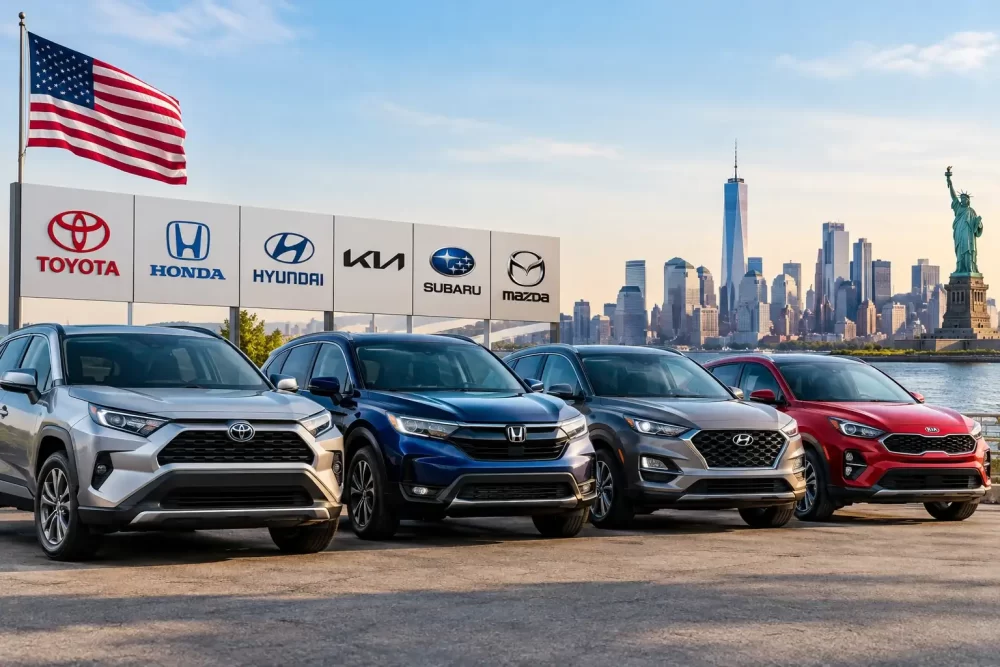
Asian automakers have strengthened their position in the U.S. market through SUVs, hybrids, technology and locally produced vehicles.
How Do Asian Car Brands Compare With American Automakers?
Asian and American automakers compete across many of the same categories, but their relative strengths depend on the type of vehicle and the needs of the buyer.
| Factor | Asian brands | American brands |
|---|---|---|
| Hybrid selection | Several manufacturers offer established hybrid lineups | Hybrid options are available from multiple manufacturers, depending on segment |
| Compact and midsize vehicles | Broad choices from Japanese and South Korean brands | Choices vary by manufacturer and segment |
| SUVs and crossovers | Extensive options from small to large family vehicles | Strong presence, including large SUVs |
| Pickup trucks | Options include midsize and full-size trucks from selected brands | Particularly strong presence in full-size pickups |
| Electric vehicles | A range of models from Japanese and South Korean manufacturers | Extensive competition, although offerings vary by company |
| Manufacturing | Significant U.S. and North American production alongside imports | Significant domestic and North American production |
| Ownership costs | Depend on the model, powertrain, insurance and resale value | Depend on the model, powertrain, insurance and resale value |
The table illustrates broad market patterns rather than a universal ranking. For instance, buyers who need a heavy-duty pickup may find that a domestic manufacturer’s lineup fits their requirements better. Someone looking for a conventional hybrid sedan may find more options from certain Japanese brands.
The most useful comparison is always between specific vehicles that fit the same budget and use case.
What About Chinese Car Brands in the U.S.?
China has become a major force in global automotive manufacturing, especially in electric vehicles and batteries. Chinese brands have expanded in several international markets, often competing on pricing, technology and rapid product development.
Their position in the United States is different from that of Japanese and South Korean manufacturers.
Chinese passenger-car brands face significant trade, regulatory and political barriers in the U.S. market. U.S. policy has also raised concerns about connected-vehicle software, data access and national security. These issues have limited the ability of Chinese-branded passenger vehicles to compete directly with established brands such as Toyota, Honda, Hyundai and Kia.
This distinction is important when discussing Asian car brands in the US. The term covers manufacturers from a large and diverse region, but the brands with substantial established U.S. passenger-car sales are primarily Japanese and South Korean.
It is also important not to confuse a brand’s ownership with a vehicle’s manufacturing origin. Automakers have global supply chains, and vehicles can contain components sourced from multiple countries.
The competitive situation may evolve as trade rules, technology requirements and business strategies change.
What Challenges Could Slow Asian Automakers’ Growth?
Strong market share does not guarantee continued growth. Asian manufacturers face several challenges that could affect their sales and profitability.
Tariffs and trade uncertainty
Changes in tariffs can raise costs for imported vehicles and components. Manufacturers may respond by adjusting prices, changing sourcing arrangements or increasing regional production. These decisions are complex because vehicle supply chains cross national borders.
Affordability and financing costs
High vehicle prices and borrowing costs can put pressure on buyers across the industry. Even brands known for practical transportation must compete for customers who are increasingly sensitive to monthly payments.
Competition in electric vehicles
Asian automakers are developing electric vehicles, but they face competition from American, European and Chinese manufacturers in markets where those brands operate. EV demand, charging access, battery costs and government policy can all influence adoption.
Product-specific reliability and quality
A strong reputation cannot compensate indefinitely for a poorly received model. Product quality, recalls, service experiences and the availability of replacement parts can influence consumer confidence.
Changing preferences
No manufacturer can assume that the popularity of a particular body style or powertrain will remain constant. Demand for hybrids, gasoline vehicles, plug-in hybrids and fully electric cars can change with fuel prices, technology and household needs.
These pressures make continued investment and product planning essential. Asian automakers must keep adapting rather than relying on the strength of their existing reputations.
What Should U.S. Buyers Consider Before Choosing an Asian Car?
For consumers, the growing range of Asian-brand vehicles creates more choice – but it can also make comparisons more complicated. A structured approach helps separate marketing claims from the factors that matter in daily use.
Before buying, ask yourself:
- What will the vehicle do most often? Commuting, family transport, long-distance driving, towing and off-road use require different capabilities.
- Would a hybrid save money? Estimate your mileage and fuel spending rather than assuming every hybrid is the better value.
- Which safety features are standard? Confirm the equipment on the exact trim you are considering.
- What is the total ownership cost? Compare purchase price, insurance, fuel, maintenance and depreciation.
- Is the vehicle comfortable in real-world driving? Test visibility, seat comfort, controls, cargo access and rear-seat space.
- Does the local service network meet your needs? Consider dealer proximity, service availability and parts support.
- How does the vehicle compare with domestic alternatives? Compare similar vehicles on price, equipment and capabilities before deciding.
A Japanese or South Korean badge can be a useful starting point, but it should not replace research into the specific model.
The Road Ahead for Asian Car Brands in America
The rise of Asian car brands in the US is the result of long-term investment, changing consumer preferences and a broad product strategy. Japanese manufacturers built substantial American businesses over decades, while South Korean automakers have become increasingly competitive through design, technology, hybrids and expanded manufacturing.
Their current momentum is particularly visible in the hybrid and crossover segments, where several Asian brands have established strong product offerings. Their U.S. manufacturing footprint and familiar dealer networks also help them compete in a market shaped by trade uncertainty and affordability concerns.
The outlook, however, is not guaranteed. Tariffs, financing costs, competition in electric vehicles and changing consumer preferences will continue to test the industry. Domestic automakers remain formidable competitors, particularly in pickups, large SUVs and other segments where they have deep experience.
For buyers, the main benefit is a wider set of choices. Comparing vehicles by total ownership cost, real-world usefulness, safety features and personal requirements is more valuable than choosing by brand origin alone.
For automakers, the message is equally clear: market share depends on offering products that meet the needs of American consumers. The brands that balance efficiency, technology, value and local market understanding are best positioned to compete as the U.S. auto market continues to evolve.
Frequently Asked Questions
Why are Asian car brands gaining market share in the U.S.?
Asian automakers are benefiting from demand for hybrids, fuel-efficient vehicles, SUVs and technology-rich cars. Long-established brand recognition, a broad product range and substantial U.S. manufacturing operations also help them compete. Cox Automotive’s September 2026 forecast projected that Asian brands would account for more than half of U.S. new-vehicle sales for a second consecutive quarter.
Which Asian car brands are most popular in America?
Toyota, Honda, Hyundai, Kia, Nissan, Subaru and Mazda are among the established Asian brands with significant U.S. market presence. Their products span compact cars, sedans, SUVs, hybrids and electric vehicles, although available models and sales performance differ by manufacturer.
Are Asian cars cheaper to maintain than American cars?
Not in every case. Maintenance costs depend on the specific model, powertrain, parts prices, service requirements and local labor rates. Buyers should compare expected maintenance, insurance, fuel costs and depreciation for the vehicles they are considering rather than relying only on brand reputation.
Are Asian automakers manufacturing vehicles in the United States?
Yes. Several Japanese and South Korean automakers operate U.S. manufacturing facilities and have invested in American production and supply chains. However, assembly location varies by model, so buyers should check the vehicle’s specific manufacturing information.
Are hybrid vehicles helping Asian automakers gain ground?
Yes. Hybrids are an important part of the explanation because they can improve fuel economy without requiring drivers to plug in. Toyota, Honda, Hyundai and Kia offer hybrid vehicles, giving buyers alternatives to conventional gasoline models and fully electric cars. Whether a hybrid is the best value depends on its price and the driver’s usage.
Are Chinese car brands widely available in the United States?
Chinese-branded passenger vehicles face significant trade and regulatory barriers in the U.S. market. Their position is therefore different from that of established Japanese and South Korean brands. Because trade and connected-vehicle policies can change, current rules should be checked when assessing future market access.
Are Asian car brands more reliable than American brands?
There is no single answer that applies to every vehicle. Some Asian manufacturers have strong reputations for reliability, but performance varies by model, year and powertrain across all automakers. Review model-specific reliability information, recalls, maintenance records and warranty coverage before buying.