Economy
BRICS and Global Manufacturing: How BRICS Could Influence the Future of Global Manufacturing

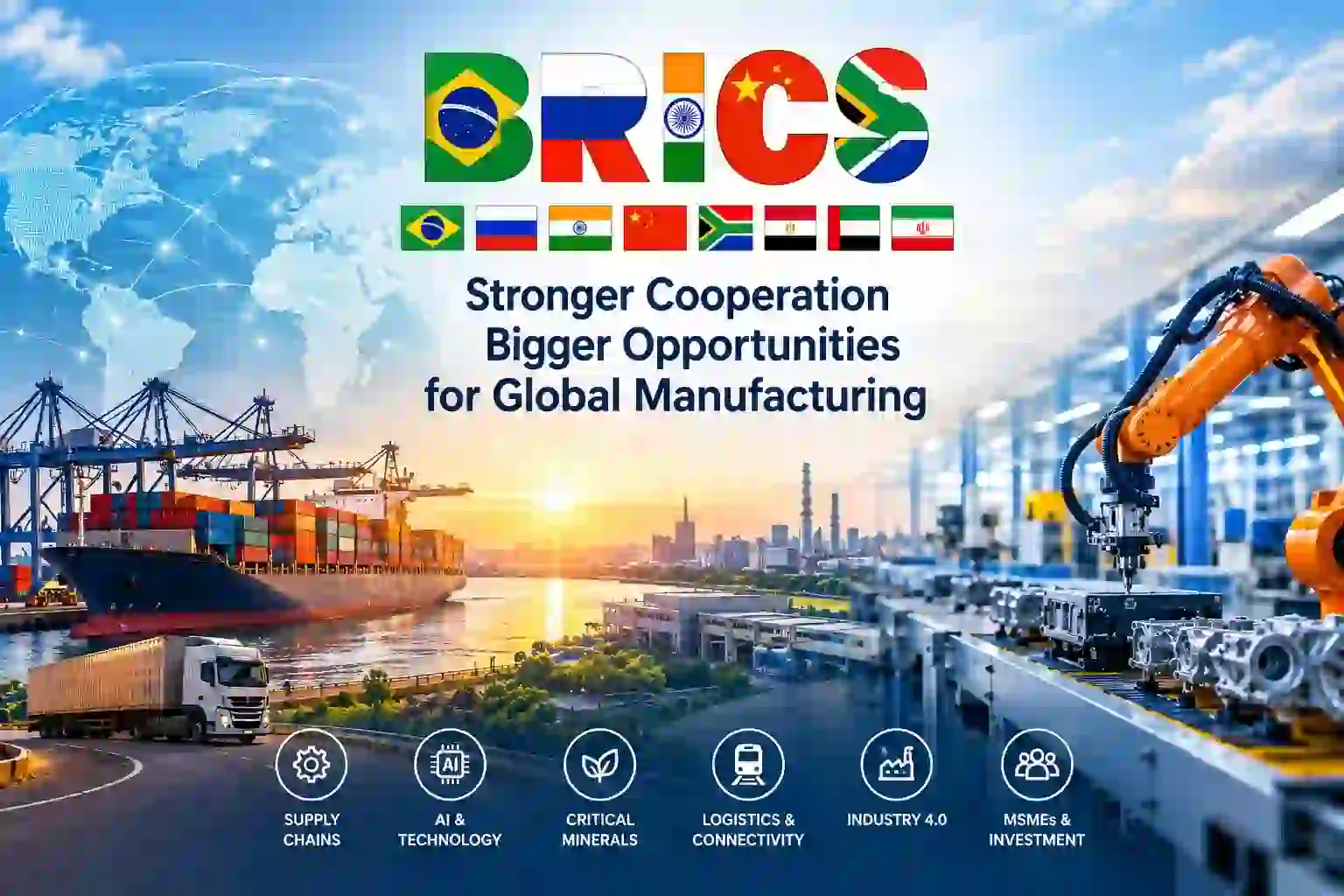
BRICS and global manufacturing could become increasingly connected as emerging economies deepen cooperation on supply chains, industrial technology, critical minerals, logistics, artificial intelligence and investment. The group’s 2026 agenda places particular emphasis on helping developing and emerging economies participate more actively in higher-value segments of global manufacturing and production.
The shift matters because the global manufacturing system is no longer defined only by low-cost labour. Companies increasingly need resilient supply chains, reliable energy, advanced technology, skilled workers, efficient logistics, access to critical minerals and diversified production locations.
The BRICS New Delhi Declaration, adopted after the 18th BRICS Summit in New Delhi on September 12-13, 2026, explicitly calls for more equitable participation by emerging markets and developing economies in higher-value manufacturing and production. It also highlights resilient Global Value Chains, technology transfer, critical infrastructure, connectivity and the BRICS GVC Action Plan 2026-2030.
So, how could BRICS influence the future of global manufacturing?
How Could BRICS Influence Global Manufacturing?
BRICS is unlikely to replace existing manufacturing centres with a single alternative industrial bloc.
A more plausible scenario is the gradual development of a more diversified and interconnected manufacturing network involving major industrial economies, resource-rich countries, technology providers, logistics hubs and emerging production centres.
The 2026 BRICS declaration identifies several areas directly relevant to this transition, including:
- Higher-value manufacturing and production
- Resilient Global Value Chains
- Technology transfer
- Industry 4.0 and intelligent manufacturing
- Artificial intelligence and digitalisation
- Critical-mineral supply chains
- Logistics and transport connectivity
- Special Economic Zones
- MSME participation in global value chains
The significance of BRICS therefore may lie less in creating one unified manufacturing system and more in connecting complementary industrial capabilities across participating economies.
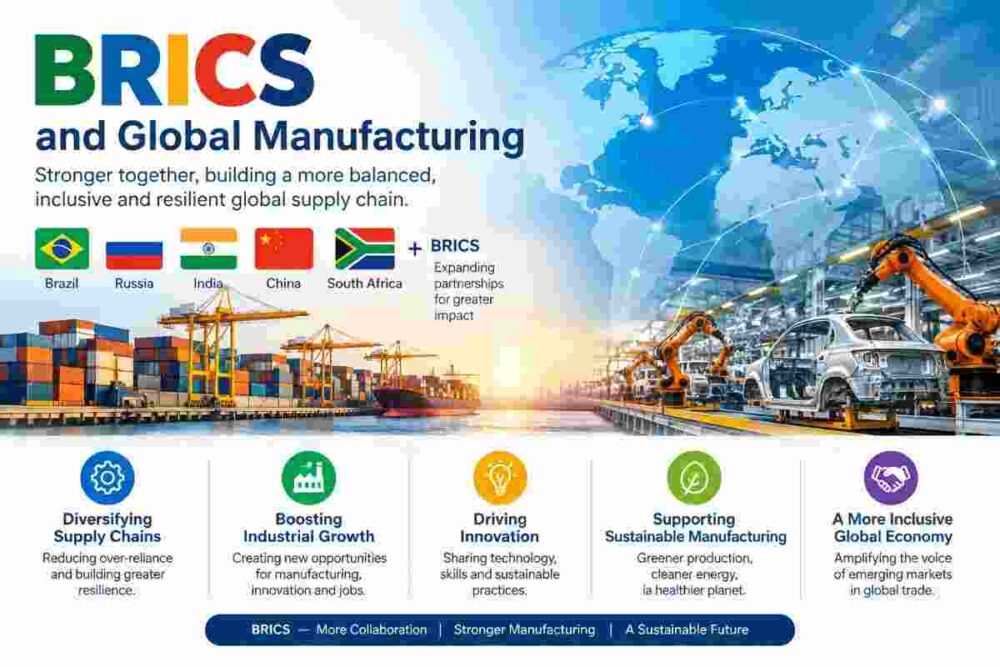
From an Economic Group to a Manufacturing Network
Manufacturing competitiveness today depends on much more than factory wages.
A modern industrial ecosystem needs reliable electricity, skilled labour, ports, roads, railways, digital infrastructure, financing, specialised suppliers, intellectual-property protection and access to advanced technologies.
The 2026 BRICS declaration recognises this broader picture. It calls for stronger participation by emerging and developing economies in higher-value segments of global manufacturing through trade and investment initiatives, technical cooperation, productive-capacity development and technology transfer.
It also stresses the need for more resilient and inclusive Global Value Chains and supports further development of the BRICS GVC Action Plan 2026-2030.
If these initiatives translate into commercial projects, BRICS countries could become more closely linked through manufacturing, components, industrial services, logistics and technology.
China Will Remain a Major Manufacturing Power
China already possesses one of the world’s deepest manufacturing ecosystems, with extensive supplier networks, industrial clusters, logistics infrastructure, engineering capabilities and large-scale production capacity.
The World Bank’s latest available data show China’s manufacturing value added at about $4.82 trillion in 2025, illustrating the scale of its industrial base.
That scale means global manufacturing diversification does not necessarily imply a simple replacement of Chinese production.
Instead, companies could increasingly combine China’s established manufacturing capabilities with expanding production networks elsewhere.
This could involve:
- Components manufactured in one country
- Assembly in another
- Engineering services from another
- Raw materials processed closer to their source
- Software and automation services delivered digitally
Such arrangements could create a more geographically diversified manufacturing system.
Could India Become a Major BRICS Manufacturing Hub?
India could play an important role in this transformation because of its large domestic market, expanding industrial base, technology ecosystem and growing interest in electronics, automobiles, renewable energy, engineering and advanced manufacturing.
World Bank data put India’s manufacturing value added at approximately $533 billion in 2025.
The 2026 BRICS declaration gives India another potential platform for industrial cooperation.
It welcomes the establishment of the India Centre for BRICS Industrial Competencies, while the broader BRICS Centre for Industrial Competencies supports manufacturing companies, including SMEs, in adopting Industry 4.0 and advanced digital production technologies. The declaration specifically identifies areas such as artificial intelligence, intelligent manufacturing, robotics, skills and technology adoption.
For India, the opportunity could therefore extend beyond exporting finished products.
Potential areas include:
electronics, auto components, engineering services, industrial machinery, robotics, automation, software, digital manufacturing and specialised components.
Moving further up these value chains could matter more than simply expanding the volume of low-cost manufacturing.
Critical Minerals Could Reshape Manufacturing Supply Chains
Critical minerals are becoming increasingly important to manufacturing because they are used in batteries, electric vehicles, renewable-energy technologies, electronics and other advanced industrial applications.
The 2026 BRICS declaration calls for reliable, diversified, resilient and sustainable critical-mineral supply chains and stresses the importance of value addition and economic diversification in resource-rich countries.
This could create an opportunity for resource-rich economies.
Instead of exporting raw minerals alone, countries could potentially develop:
mining → processing → refining → component manufacturing → finished products
closer to the source.
That could increase the share of economic value retained locally.
For manufacturers, diversified mineral supply could also reduce exposure to disruptions affecting a small number of suppliers or production centres.
Could BRICS Create More Resilient Global Supply Chains?
Supply-chain resilience has become an increasingly important consideration for global businesses.
Manufacturers face risks from trade restrictions, geopolitical tensions, shipping disruptions, energy shortages, raw-material bottlenecks and regional economic shocks.
The 2026 BRICS declaration places strong emphasis on making Global Value Chains more resilient, efficient, predictable, transparent, secure, stable and inclusive. It also calls for greater cooperation in trade facilitation, critical infrastructure, industrial capacity, connectivity and technology access.
This could encourage companies to move from a simple “lowest-cost location” strategy toward a broader “cost plus resilience” approach.
That does not mean every company will move production.
Instead, businesses may increasingly consider having multiple production or sourcing locations where commercially viable.
BRICS Logistics Cooperation Could Matter More Than It Appears
Factories cannot operate efficiently without reliable transportation.
Raw materials must arrive on time. Components need to move between suppliers. Finished products need access to domestic and international markets.
The 2026 BRICS declaration welcomed the establishment of a BRICS Logistics Supply-Chain Cooperation Framework and encouraged deeper transport cooperation, including work related to rail connectivity and sustainable transport infrastructure.
The significance could extend beyond physical infrastructure.
Better logistics systems could eventually involve:
- Digital trade documentation
- Improved customs processes
- Better port connectivity
- Rail and road links
- Logistics data platforms
- More coordinated supply-chain procedures
The practical effect would depend on how these initiatives are implemented by individual countries.
Could Special Economic Zones Become Manufacturing Gateways?
Special Economic Zones, or SEZs, could become another important part of the BRICS manufacturing story.
The 2026 declaration says BRICS members should explore the potential of SEZs as mechanisms for promoting trade, investment, industrial cooperation, innovation and integration into resilient and sustainable Global Value Chains. It also highlights infrastructure, streamlined regulatory procedures and digitalisation of trade documentation.
This creates the possibility of stronger connections between industrial parks across different BRICS economies.
For example, a multinational company could potentially source raw materials from one market, process them in another, manufacture components in a third and serve customers across several regions.
The success of such a model would depend heavily on customs rules, logistics costs, investment regulations and commercial viability.
Artificial Intelligence Is Changing the Factory Floor
The future of manufacturing will increasingly depend on data and software as well as machines.
Artificial intelligence can be used to:
- Predict equipment maintenance needs
- Detect defects
- Improve production planning
- Reduce waste
- Optimise energy consumption
- Analyse supply-chain data
Robotics can automate repetitive processes, while digital systems can help manufacturers monitor and simulate production environments.
The 2026 BRICS declaration specifically recognises work by the Intelligent Manufacturing and Robotics Working Group and efforts involving smart-factory development, technology sharing, standards cooperation and talent development. It also highlights the role of the BRICS Centre for Industrial Competencies in helping manufacturers adopt Industry 4.0 and advanced digital-production technologies.
For smaller manufacturers, access to shared knowledge and technology could be particularly significant.
Why MSMEs Could Be Important to BRICS Manufacturing
Large multinational corporations receive much of the attention when manufacturing is discussed, but industrial supply chains depend heavily on small and medium-sized companies.
An automobile manufacturer, for example, can depend on hundreds or even thousands of suppliers producing components, software, tools, machinery and specialised services.
The 2026 BRICS declaration highlights the internationalisation of MSMEs and recognises access to finance as a major constraint on their participation in trade and Global Value Chains.
It also welcomes a Framework for Cooperation in the SME Working Group and initiatives aimed at improving access to finance and technology.
If these mechanisms lead to greater cross-border participation, MSMEs could become an important channel through which manufacturing cooperation reaches smaller cities, industrial clusters and local supplier networks.
What Does BRICS Manufacturing Cooperation Mean for India?
For India, the implications could extend across several parts of the manufacturing ecosystem.
Potential areas of opportunity include:
Electronics: component manufacturing, assembly and specialised electronics.
Automobiles: electric vehicles, auto components, batteries and engineering.
Industrial machinery: machine tools, automation equipment and industrial systems.
Renewable energy: components for solar, wind, batteries and other clean-energy technologies.
Digital manufacturing: AI, industrial software, robotics and Industry 4.0 solutions.
Engineering services: design, testing, research and specialised technical services.
India’s opportunity may therefore not be limited to attracting factories. It could also involve developing the supplier ecosystem surrounding those factories.
What Could BRICS Mean for Global Manufacturers?
For multinational manufacturers, deeper BRICS cooperation could create both opportunities and challenges.
Potential opportunities include:
- More production locations
- New supplier markets
- Access to growing consumer markets
- Alternative sourcing options
- Greater access to raw materials
- New industrial partnerships
- Technology and engineering collaboration
At the same time, companies would have to navigate differences in regulations, infrastructure, currencies, trade policies, intellectual-property regimes and business environments.
BRICS cooperation therefore does not automatically mean that manufacturing becomes easier.
It could mean that companies have more strategic options.
BRICS Faces Significant Manufacturing Challenges
The potential of BRICS manufacturing cooperation should not be confused with guaranteed results.
BRICS economies differ substantially in industrial capabilities, regulations, infrastructure, financial systems and policy priorities.
Even when governments agree on cooperation, businesses ultimately need projects that are commercially viable.
Manufacturers need:
- Predictable regulations
- Reliable infrastructure
- Skilled workers
- Competitive logistics
- Access to finance
- Intellectual-property protection
- Consistent energy supply
- Efficient customs procedures
The 2026 BRICS declaration itself acknowledges the need for practical cooperation, infrastructure, capacity building, trade facilitation and technology access.
The key question is therefore not simply whether BRICS announces new manufacturing initiatives.
It is whether those initiatives translate into factories, suppliers, investment, technology adoption, trade and jobs.
Will BRICS Replace China as the World’s Factory?
There is no basis for assuming that BRICS will simply replace China as the world’s primary manufacturing centre.
China’s industrial scale and supplier ecosystem remain significant. At the same time, other BRICS economies can develop complementary capabilities.
A more plausible long-term scenario is manufacturing diversification.
China could remain a major production centre while countries such as India, Brazil and other participating economies expand in selected industries, components, processing, energy-related manufacturing, logistics and industrial services.
That would result in a more distributed manufacturing system rather than a single replacement for China.
What Could This Mean for Workers?
The transformation could affect employment as well as factories and supply chains.
Growing manufacturing activity could increase demand for:
- Engineers
- Technicians
- Robotics specialists
- Machine operators
- Data analysts
- Industrial software professionals
- Supply-chain specialists
- Quality-control experts
However, increased automation could also reduce demand for some repetitive tasks.
That makes skills development and workforce training critical for countries seeking to capture more manufacturing value.
The factory of the future will increasingly require workers who understand both physical production and digital technology.
Is BRICS Creating a Multipolar Manufacturing System?
The broader impact of BRICS may ultimately be a shift toward a more multipolar manufacturing system.
The goal would not necessarily be to create one unified BRICS industrial base.
Instead, different economies could contribute different strengths:
China: large-scale manufacturing and mature supplier ecosystems.
India: engineering, digital capabilities, electronics, automobiles and expanding advanced manufacturing.
Brazil: large industrial, agricultural and energy-related capabilities.
Other participating economies: energy, minerals, logistics, finance, industrial services and specialised production.
The effectiveness of this model will depend on how well these capabilities can be connected through trade, investment, logistics and technology.
The Future of Global Manufacturing May Be More Diversified
BRICS is unlikely to transform global manufacturing overnight.
Factories, supplier networks, logistics systems and skilled workforces take years to build.
But the direction of cooperation is becoming clearer.
The 2026 BRICS New Delhi Declaration places manufacturing within a much broader framework that includes resilient Global Value Chains, higher-value production, technology transfer, critical minerals, logistics, SEZs, Industry 4.0, AI and MSMEs. It also supports the BRICS GVC Action Plan 2026-2030 and the development of practical industrial competencies.
For global manufacturers, the result could be a wider choice of production and sourcing locations.
For emerging economies, it could create opportunities to move beyond raw-material exports and low-value manufacturing into processing, components, engineering, technology and higher-value production.
For India, the opportunity could be particularly significant if manufacturing growth is supported by stronger supplier networks, infrastructure, skills and technology adoption.
The biggest question is therefore not whether BRICS will replace the existing global manufacturing system.
It is whether BRICS cooperation can help create a more diversified, resilient and higher-value global manufacturing network.
And the real test will be whether today’s declarations ultimately translate into investment, factories, supply chains, technology and jobs.
Key Takeaways
BRICS manufacturing cooperation is becoming broader. The 2026 agenda covers industrial capacity, GVCs, logistics, critical minerals, Industry 4.0, AI and MSMEs. [UNCTAD global trade analysis key statistics and trends in International Trade 2025.]
China is likely to remain an important manufacturing centre, while other BRICS economies can develop complementary industrial capabilities.
India could benefit from supply-chain diversification, particularly in electronics, engineering, automobiles, digital manufacturing and industrial technology.
Critical minerals could become strategically important as BRICS members pursue diversified supply chains and greater value addition.
Logistics and SEZ cooperation could determine how practical the manufacturing ambitions become.
MSMEs could play a major role if access to finance, technology and international markets improves.
Frequently Asked Questions
What is BRICS manufacturing cooperation?
BRICS manufacturing cooperation refers to efforts by BRICS countries to work together on industrial capacity, Global Value Chains, technology transfer, advanced manufacturing, logistics, critical minerals, MSMEs and related areas.
How could BRICS affect global manufacturing?
BRICS could contribute to greater diversification of production and supply chains by encouraging investment, industrial cooperation, technology transfer, logistics connectivity and greater participation by emerging economies in higher-value manufacturing.
Could BRICS replace China as the world’s factory?
Not necessarily. China’s existing manufacturing scale and supplier networks remain substantial. A more plausible development is greater diversification, with other BRICS economies expanding their own manufacturing capabilities alongside China.
Why is India important to BRICS manufacturing?
India has a large domestic market, expanding industrial capabilities and growing strengths in areas including electronics, automobiles, engineering and digital technologies. The 2026 BRICS agenda also includes the India Centre for BRICS Industrial Competencies.
What role will critical minerals play in BRICS manufacturing?
Critical minerals are important for batteries, electric vehicles, renewable energy, electronics and other advanced technologies. BRICS has called for diversified and resilient critical-mineral supply chains while promoting value addition and economic diversification in resource-rich countries.
How can AI affect BRICS manufacturing?
AI can support predictive maintenance, quality control, production planning, energy optimisation and other industrial applications. BRICS is developing cooperation around intelligent manufacturing, robotics, Industry 4.0 and advanced digital-production technologies.
What are BRICS Global Value Chains?
Global Value Chains, or GVCs, are international production networks in which different stages of making a product – such as sourcing, processing, component production, assembly and services – take place across different countries. The 2026 BRICS declaration supports further development of the BRICS GVC Action Plan 2026-2030.
Could BRICS manufacturing create jobs?
Expanded industrial investment could increase demand for engineers, technicians, machine operators, data professionals, robotics specialists and supply-chain workers. However, greater automation could also reduce demand for some repetitive roles, making skills development important.
What is the BRICS Logistics Supply-Chain Cooperation Framework?
It is a BRICS initiative intended to strengthen cooperation around logistics and supply chains. The 2026 declaration welcomed its establishment as part of wider efforts to improve transport connectivity and supply-chain resilience.
What is the BRICS Centre for Industrial Competencies?
The BRICS Centre for Industrial Competencies supports manufacturing companies, including SMEs, in adopting Industry 4.0 and advanced digital-production technologies. The 2026 declaration also welcomed the establishment of the India Centre for BRICS Industrial Competencies.