Delhi
Delhi Solar Portal 2026: How to Apply for Rooftop Solar Subsidy

Last Updated: September 24, 2026
Delhi residents looking to reduce their electricity bills and generate clean energy from their rooftops can apply for rooftop solar through the Delhi Solar Portal and the PM Surya Ghar: Muft Bijli Yojana.
The Delhi government’s official solar portal currently provides information on rooftop solar subsidies, application procedures, empanelled vendors, subsidy status, solar calculators and different models for consumers, including community solar and group net metering.
Under the current Delhi Solar Muft Bijli Yojana, the scheme is scheduled to close on February 28, 2027, and benefits are available on a first-come, first-served basis to the first 2,20,000 eligible consumers. The portal showed 22,221 applications as of September 24, 2026.
If you are planning to install rooftop solar in Delhi in 2026, this guide explains the Delhi Solar Portal registration process, rooftop solar subsidy, eligibility, installation cost, generation-based incentives, application procedure, vendor selection, subsidy tracking and frequently asked questions.
Delhi Solar Portal 2026: At a Glance
| Particular | Details |
|---|---|
| Scheme | Delhi Solar Muft Bijli Yojana |
| Central scheme | PM Surya Ghar: Muft Bijli Yojana |
| Application platform | Delhi Solar Portal / National Portal |
| Scheme closing date | February 28, 2027 |
| Eligible consumers | First 2,20,000 eligible consumers |
| Maximum central subsidy for residential systems | ₹78,000 |
| Delhi state capital subsidy | ₹2,000 per kW, up to ₹10,000 |
| Residential GBI | Up to ₹3/kWh depending on system size |
| RWA/GHS central subsidy | ₹18,000 per kW, subject to applicable limits |
| Application mode | Online |
Important: Subsidy amounts, eligibility and scheme timelines can change. Applicants should check the official Delhi Solar Portal and PM Surya Ghar portal before submitting an application.
What Is the Delhi Solar Portal?
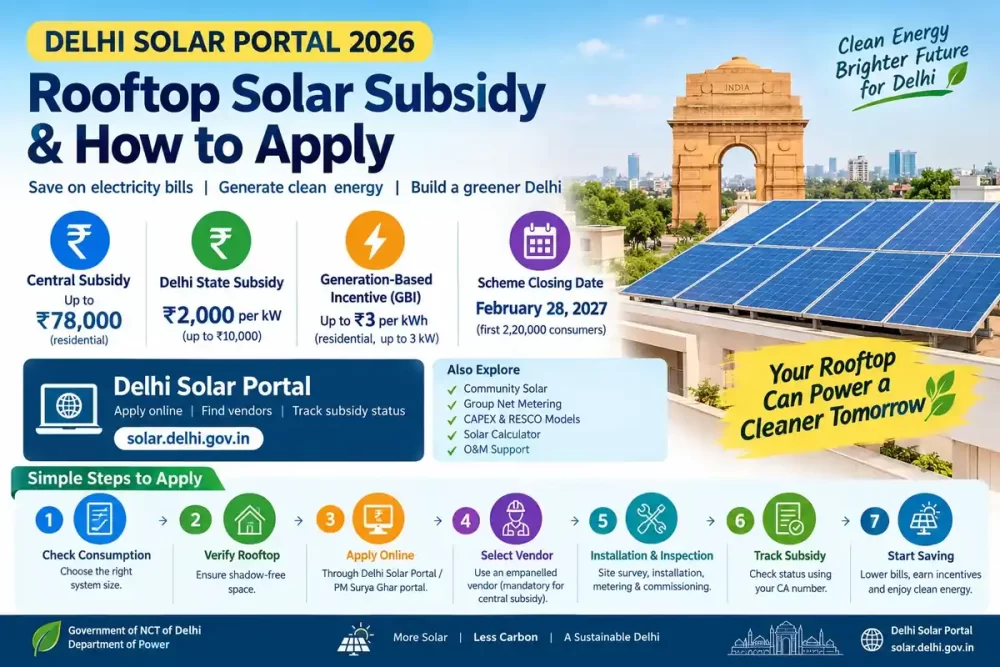
A guide to Delhi’s rooftop solar subsidy, PM Surya Ghar benefits and online application process in 2026.
The Delhi Solar Portal is the online platform of the Energy Efficiency and Renewable Energy Management Centre under the Department of Power, Government of NCT of Delhi.
It provides information and online services related to rooftop solar installations in Delhi, including:
- Rooftop solar subsidies
- PM Surya Ghar applications
- Delhi state subsidy
- Generation-based incentives
- Empanelled solar vendors
- Solar installation models
- Capital subsidy status
- Solar rooftop calculator
- Consumer services and grievances
- Community solar
- Group net metering
- Operation and maintenance information
The portal was updated on September 24, 2026, and currently states that the Delhi Solar Muft Bijli Yojana closes on February 28, 2027.
What Is the PM Surya Ghar Rooftop Solar Subsidy?
The PM Surya Ghar: Muft Bijli Yojana provides central financial assistance to eligible residential consumers installing rooftop solar systems.
According to the current Delhi Solar Portal, the central subsidy for residential households is:
| Solar Capacity | Central Subsidy |
|---|---|
| Up to 2 kW | ₹30,000 per kW |
| Additional capacity from 2 kW to 3 kW | ₹18,000 per kW |
| Systems above 3 kW | Maximum ₹78,000 |
This means that a qualifying residential consumer can receive a maximum central subsidy of ₹78,000 for a rooftop solar installation.
Example
For a 3 kW system:
- First 2 kW × ₹30,000 = ₹60,000
- Additional 1 kW × ₹18,000 = ₹18,000
- Total central subsidy = ₹78,000
A system larger than 3 kW does not receive a higher central subsidy because the residential central subsidy is capped at ₹78,000.
Delhi State Solar Subsidy 2026
In addition to the central financial assistance, the Delhi Solar Energy Policy provides a state capital subsidy for residential consumers.
The current Delhi Solar Portal states that residential consumers are eligible for:
₹2,000 per kW, subject to a maximum of ₹10,000 per consumer.
The state subsidy is passed through the consumer’s first electricity bill after commissioning of the rooftop solar system.
Therefore, eligible residential consumers may potentially receive both:
- Central subsidy under PM Surya Ghar
- Delhi state capital subsidy
The exact amount applicable to an individual installation should be checked through the official portal and applicable scheme rules before installation.
Generation-Based Incentive for Delhi Solar Consumers
Delhi’s solar policy also provides a Generation-Based Incentive (GBI) based on the electricity generated by a rooftop solar system.
For residential consumers, the current Delhi Solar Energy Policy information lists:
| Consumer/System Category | Generation-Based Incentive |
|---|---|
| Residential systems up to 3 kW | ₹3 per kWh |
| Residential systems above 3 kW and up to 10 kW | ₹2 per kWh |
| GHS/RWA systems up to 500 kW | ₹2 per kWh |
| Commercial & industrial consumers for the first 200 MW deployed | ₹1 per kWh |
The Delhi Solar Portal states that the policy provides these generation-based incentives in addition to the applicable central financial assistance and state capital subsidy.
The GBI should not be confused with the upfront capital subsidy. The capital subsidy reduces the initial installation cost, while the GBI is linked to solar electricity generation.
How Much Rooftop Space Is Required for Solar in Delhi?
The Delhi Solar Portal’s solar calculator estimates that approximately 10 square metres, or about 100 square feet, of rooftop area is required for a 1 kW solar plant.
However, the actual usable area can vary because rooftops may contain:
- Water tanks
- Parapets
- Staircase structures
- Antennas
- Other equipment
- Areas affected by shade
The portal notes that rooftop utilisation may initially be around 20% in some cases and can potentially be increased with elevated structures.
Approximate Space Requirement
| Solar System | Approximate Area |
|---|---|
| 1 kW | 100 sq ft |
| 2 kW | 200 sq ft |
| 3 kW | 300 sq ft |
| 5 kW | 500 sq ft |
These are broad planning estimates rather than guaranteed installation requirements. A solar vendor should conduct a site assessment before finalising the system size.
How Much Does Rooftop Solar Cost in Delhi?
The Delhi Solar Portal’s calculator currently uses approximate installation costs of:
- ₹60,000 per kW for systems up to 5 kW
- ₹55,000 per kW for systems from 6 kW to 10 kW
- ₹50,000 per kW for systems above 10 kW
Actual quotations can differ depending on equipment, roof structure, installation requirements, wiring, inverter specifications, metering and other project-specific factors.
For example, a 3 kW installation using the portal’s indicative ₹60,000-per-kW figure would have an approximate gross installation cost of ₹1.80 lakh before applicable subsidies.
The actual amount payable after subsidies should be calculated using the applicable scheme rules and the vendor’s final quotation.
Who Can Benefit From Rooftop Solar in Delhi?
Rooftop solar can be relevant to several categories of consumers.
1. Individual Homeowners
Homeowners with suitable shadow-free roof space can install a rooftop solar system under the applicable residential scheme.
2. Apartment Residents
People living in apartments may not always have individual roof rights or sufficient rooftop space. Delhi’s solar policy provides alternative models such as community solar and group-based arrangements.
3. Group Housing Societies and RWAs
Group Housing Societies and Resident Welfare Associations can install solar systems for common facilities and may also qualify for applicable central subsidy support.
4. Consumers With Limited Roof Space
The Delhi Solar Portal specifically provides information on community solar for consumers who do not have suitable rooftop space, including tenants and apartment dwellers.
Rooftop Solar Subsidy for RWAs and Group Housing Societies
The PM Surya Ghar subsidy structure also provides support for Group Housing Societies and Resident Welfare Associations.
The Delhi Solar Portal currently lists central financial assistance of:
₹18,000 per kW for common facilities, including EV charging, up to 500 kW capacity at 3 kW per house, subject to the applicable upper limit and scheme conditions.
This can make rooftop solar particularly relevant for common-area electricity consumption in apartment complexes and housing societies.
RWAs should verify the current eligibility criteria and applicable installation model before proceeding.
Delhi Solar Portal: How to Apply for Rooftop Solar Subsidy in 2026
The application process involves several stages.
Step 1: Check Your Electricity Consumption
Start by reviewing your monthly electricity consumption.
The Delhi Solar Portal provides indicative system-size recommendations based on average monthly consumption:
| Average Monthly Consumption | Suggested Solar Capacity |
|---|---|
| 0–150 units | 1–2 kW |
| 150–300 units | 2–3 kW |
| More than 300 units | Above 3 kW |
These are indicative recommendations; the final system size should also consider available roof area and other technical factors.
Step 2: Check Your Rooftop
Determine whether you have sufficient shadow-free rooftop space.
Check for:
- Shade from neighbouring buildings
- Water tanks
- Trees
- Parapets
- Staircases
- Existing rooftop equipment
The solar calculator on the Delhi Solar Portal can be used to estimate feasible system capacity based on electricity consumption and available rooftop area.
Step 3: Apply Through the Solar Portal
Eligible consumers can begin the rooftop solar application process through the Delhi Solar Portal.
For the PM Surya Ghar scheme, applications are submitted through the National Portal at pmsuryaghar.gov.in. The Delhi Solar Portal provides the relevant application route.
Applicants should keep their electricity consumer details and other required information ready before starting the application.
Step 4: Select an Eligible Solar Vendor
Consumers applying under PM Surya Ghar must select a vendor empanelled under the PM Surya Ghar portal to claim the central subsidy.
The Delhi Solar Portal provides separate vendor links for Delhi’s distribution areas, including BRPL, BYPL, TPDDL, NDMC and MES.
Before finalising a vendor, consumers should compare:
- System capacity
- Solar panel specifications
- Inverter specifications
- Warranty
- Installation cost
- Maintenance terms
- Metering arrangements
- Expected generation
- Subsidy-related documentation
Step 5: Site Survey and Installation
After vendor selection, the rooftop is assessed for installation feasibility.
The vendor determines the appropriate system design and proceeds with installation after the required approvals.
Consumers should carefully review the quotation and agreement before installation.
Step 6: Inspection and Commissioning
Once the rooftop solar system has been installed, the required inspection, metering and commissioning procedures are completed through the applicable DISCOM and scheme process.
Consumers should retain all documents, invoices, approvals and warranties.
Step 7: Track Your Subsidy
Delhi residents can use the Capital Subsidy Status section of the Delhi Solar Portal to check whether their capital subsidy has been released.
The portal allows consumers to search using their Consumer Account (CA) Number.
What About Solar for Apartments and Tenants?
One of the important developments in Delhi’s solar policy is that consumers without suitable individual rooftops are not necessarily excluded from solar adoption.
The Delhi Solar Portal describes a Community Solar Model for consumers who do not have suitable roof space, including:
- Tenants
- Apartment residents
- Consumers with small rooftops
- Consumers with shaded rooftops
Under this model, consumers can purchase a share of a third-party-owned solar photovoltaic system, subject to the applicable framework.
The portal also provides information on other models, including:
- Community Solar
- Group Net Metering
- RESCO
- Hybrid RESCO
- CAPEX
These options allow consumers with different financial and rooftop constraints to explore different ways of adopting solar power.
CAPEX vs RESCO: Which Solar Model Applies?
Delhi provides multiple pathways for rooftop solar adoption.
CAPEX Model
Under the CAPEX model, the consumer purchases the solar system and becomes its owner.
This model is generally relevant for consumers who:
- Have suitable roof space
- Can afford the upfront investment
- Want to own the solar system
The Delhi Solar Portal states that consumers can purchase the system from a solar vendor and sell excess electricity to the grid according to the applicable framework.
RESCO Model
Under a RESCO arrangement, a third-party solar developer owns and operates the system under the applicable agreement.
This can provide an alternative for consumers who may not want to make the entire upfront investment.
Community Solar
Community solar is designed for consumers who may not have suitable individual rooftop space.
Delhi’s solar portal specifically identifies tenants and apartment dwellers among potential users of this model.
How Much Can You Save With Rooftop Solar?
The actual savings from rooftop solar depend on several factors, including:
- System capacity
- Electricity consumption
- Solar generation
- Rooftop orientation
- Shading
- Electricity tariff
- Net-metering arrangements
- Applicable subsidy
- Generation-based incentive
- Maintenance costs
Therefore, there is no single savings figure that applies to every Delhi household.
The Delhi Solar Portal provides a Solar Rooftop Calculator that estimates:
- Feasible rooftop solar capacity
- Installation cost
- Central subsidy
- State subsidy
- Effective cost
- Monthly generation-based incentive
- Monthly electricity-bill savings
- Estimated monthly benefits
- Payback period
Consumers should use the calculator as an estimate rather than treating its output as a guaranteed financial return.
Rooftop Solar and Electricity Bills
One of the major reasons households consider rooftop solar is the potential reduction in electricity purchased from the grid.
The Delhi Solar Portal highlights rooftop solar as a way to reduce electricity consumption and electricity bills. It also identifies generation-based incentives and energy independence among the benefits of rooftop solar adoption.
However, the actual electricity bill after installation depends on consumption patterns, solar generation, applicable tariff structure and the treatment of exported electricity.
Is Operation and Maintenance Included?
Consumers should pay close attention to maintenance terms when selecting a vendor.
For PM Surya Ghar installations, the Delhi Solar Portal states that the vendor responsible for installation will provide cleaning and all-inclusive operation and maintenance for five years, including rectification of faults or issues at the vendor’s cost, subject to the applicable scheme conditions.
Consumers should also retain documentation relating to:
- Solar panel warranties
- Inverter warranty
- Installation warranty
- O&M agreement
- Equipment specifications
- Bills and invoices
The portal notes that solar panels typically have long-term warranties, while inverter warranties are generally shorter.
Delhi Solar Portal 2026: Important Things to Check Before Applying
Before submitting your application, check the following:
✔ Electricity connection details
Keep your electricity consumer/CA number readily available.
✔ Rooftop suitability
Make sure the roof has adequate shadow-free space.
✔ System capacity
Do not automatically choose the largest system. Consider your electricity consumption and available rooftop area.
✔ Vendor
For PM Surya Ghar subsidy claims, use the applicable empanelled vendor.
✔ Quotation
Compare the complete installation quotation rather than looking only at the advertised price per kW.
✔ Subsidy
Confirm the applicable central and Delhi state subsidy before calculating your final cost.
✔ Metering
Understand the applicable metering and grid-connection process.
✔ Warranty and maintenance
Read the vendor’s warranty and five-year O&M terms carefully where applicable.
✔ Documents
Keep copies of applications, approvals, invoices, agreements, commissioning documents and warranties.
Delhi Solar Portal Subsidy Status: How to Check
If your rooftop solar installation has already been completed and you are waiting for the capital subsidy, you can check its status through the Delhi Solar Portal.
The portal’s Capital Subsidy Status service requires the consumer’s CA Number to search for the subsidy release status.
If you have questions regarding your subsidy or installation, the Delhi Solar Portal advises consumers to contact their respective DISCOM office.
Delhi Solar Portal 2026: Frequently Asked Questions
1. What is the Delhi Solar Portal?
The Delhi Solar Portal is the Government of NCT of Delhi’s online platform for rooftop solar information and services, including subsidies, vendors, solar calculators, applications and subsidy-status services.
2. How much rooftop solar subsidy is available in Delhi in 2026?
Under the current central financial assistance structure, eligible residential consumers can receive central financial assistance of ₹30,000 per kW for the first 2 kW and ₹18,000 per kW for the additional capacity up to 3 kW, with the total central subsidy capped at ₹78,000. Consumers can also refer to the official PM Surya Ghar operational guidelines and subsequent amendments issued by the Ministry of New and Renewable Energy (MNRE) for the applicable subsidy framework and implementation provisions.
Delhi also provides a state capital subsidy of ₹2,000 per kW for residential consumers, subject to a maximum of ₹10,000 per consumer under the applicable Delhi Solar Energy Policy.
3. What is the last date to apply for the Delhi Solar Muft Bijli Yojana?
The Delhi Solar Portal currently states that the scheme closes on February 28, 2027. The portal also states that benefits are available on a first-come, first-served basis to the first 2,20,000 eligible consumers.
4. What is the maximum central solar subsidy for a household?
The maximum central subsidy for an eligible residential installation is ₹78,000 under the current PM Surya Ghar subsidy structure.
5. Can apartment residents benefit from solar power?
Yes. Delhi’s solar policy includes models such as community solar that can serve consumers who do not have suitable individual rooftop space, including apartment dwellers and tenants.
6. Can an RWA install rooftop solar?
Yes. Group Housing Societies and RWAs can explore applicable rooftop solar arrangements, including systems for common facilities. The current Delhi Solar Portal lists central subsidy support of ₹18,000 per kW for eligible common facilities, subject to the applicable limits and scheme conditions.
7. How much roof space is required for a 1 kW solar system?
The Delhi Solar Portal’s calculator uses approximately 100 square feet or 10 square metres per 1 kW as a general planning estimate. Actual requirements can vary depending on the rooftop layout and shading.
8. How can I check my solar subsidy status?
You can use the Capital Subsidy Status facility on the Delhi Solar Portal and enter your Consumer Account (CA) Number.
9. Do I have to select an empanelled vendor?
For consumers applying under PM Surya Ghar, the Delhi Solar Portal states that choosing a vendor empanelled with the PM Surya Ghar portal is mandatory for claiming the central government subsidy.
10. Is rooftop solar worth considering in Delhi?
Rooftop solar can reduce grid electricity consumption and may provide savings and applicable generation-based incentives. The financial outcome varies according to system size, electricity consumption, generation, tariff, subsidies and installation costs. Consumers should use the Delhi Solar Portal’s calculator and obtain a site-specific quotation before making a decision.
Final Takeaway
The Delhi Solar Portal 2026 provides Delhi residents with a central online resource for understanding and applying for rooftop solar benefits.
For eligible residential consumers, the current PM Surya Ghar structure provides central financial assistance of up to ₹78,000, while Delhi’s solar policy provides an additional state capital subsidy of up to ₹10,000, subject to applicable eligibility and scheme conditions. Delhi also provides generation-based incentives and alternative solar models for consumers who have different rooftop and financing constraints.
With the Delhi Solar Muft Bijli Yojana currently scheduled to close on February 28, 2027, consumers interested in rooftop solar should check their eligibility, rooftop suitability, applicable subsidy and vendor requirements through the official portal before proceeding.
The most important point is to rely on the latest official Delhi Solar Portal and PM Surya Ghar information, because subsidy rules, application procedures, vendor lists and scheme availability can change.
Official Resources
Delhi Solar Portal: Delhi Solar Portal, Government of NCT of Delhi
PM Surya Ghar: National Portal for Rooftop Solar
Delhi Solar Policy: Delhi Solar Energy Policy
Capital Subsidy Status: Available through the Delhi Solar Portal using the Consumer Account (CA) Number.