AI
Why Artificial Intelligence Could Put Pressure on the World’s Electricity Supply

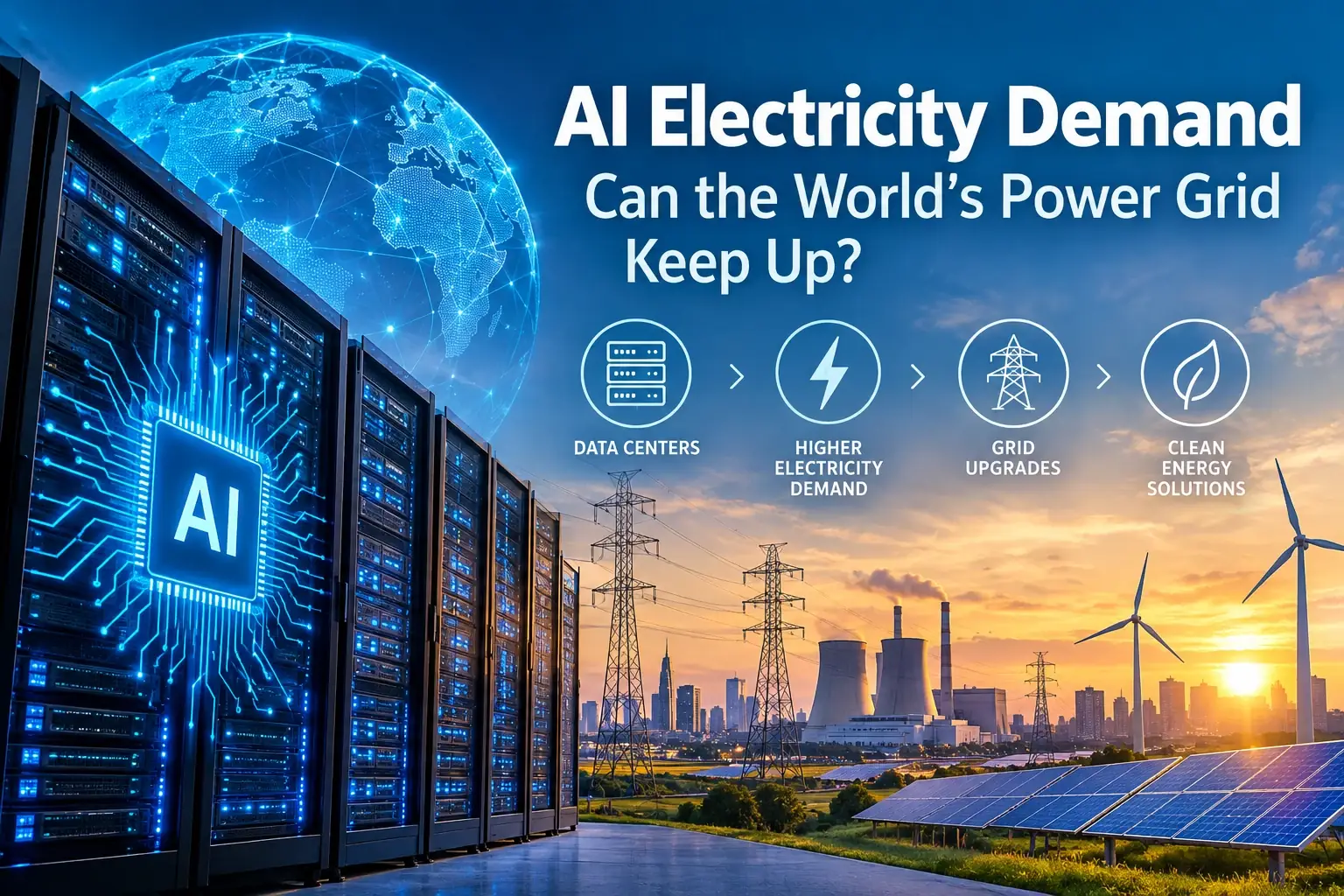
Artificial intelligence is transforming industries, from healthcare and finance to manufacturing, transport and entertainment. But behind every AI chatbot response, generated image and automated business process is a physical infrastructure that consumes electricity: data centres filled with powerful processors, storage systems, networking equipment and cooling technology.
As AI adoption accelerates, AI electricity demand is becoming an increasingly important issue for energy companies, policymakers, businesses and consumers. Data centres need reliable power around the clock, while electricity grids in many regions are already facing rising demand, ageing infrastructure and delays in building new transmission lines.
The challenge is not simply whether the world can generate more electricity. It is whether enough power can be delivered to the right locations, at the right time and at a cost that households and businesses can afford.
The International Energy Agency (IEA) expects global data-centre electricity consumption to rise substantially by 2030, with AI among the major drivers. Although data centres will remain a relatively small share of total global electricity use, their concentrated demand could create significant challenges for particular cities, regions and power networks.
Here is why AI could put pressure on the world’s electricity supply, what it means for the United States and India, and how cleaner energy, grid upgrades and more efficient technology could help manage the growing demand.
How AI Is Increasing Electricity Demand
Artificial intelligence depends on computing infrastructure that requires electricity at every stage. AI models are trained using large amounts of data and computing power, while inference – the process of using a trained model to generate an answer, prediction or other output – requires energy every time the system is used.
The electricity requirements vary considerably. A simple text request may use relatively little energy compared with a complex reasoning task, extensive data analysis or the generation of high-resolution video. The energy footprint also depends on the model, hardware, data-centre design, cooling system and the amount of computing performed.
Three major activities contribute to AI-related electricity demand.
1. Training Large AI Models
Training involves processing enormous datasets and repeatedly adjusting a model’s parameters. Advanced AI models may require thousands of specialised processors operating together for extended periods.
This process can consume substantial amounts of electricity, particularly when developers train larger models or conduct multiple training runs. However, training is only one part of the overall energy picture.
2. Running AI Applications
Once an AI model is deployed, it consumes electricity whenever users or businesses interact with it. This includes chatbots, coding assistants, recommendation engines, image generators, enterprise software and AI-powered search.
As AI becomes integrated into everyday digital services, the number of requests can increase significantly. The cumulative energy used to operate these services may become just as important as the electricity consumed during model training.
3. Cooling and Supporting Data Centres
Processors generate heat, making cooling systems essential for reliable operations. Data centres also need electricity for networking equipment, storage, lighting, power conversion and other infrastructure.
Consequently, a data centre’s total electricity consumption is higher than the power used by its AI processors alone. Cooling efficiency, climate, building design and the type of computing equipment all influence its overall energy requirements.
It is also important to distinguish AI electricity demand from total data-centre electricity consumption. Data centres support conventional cloud computing, online services, enterprise applications and data storage, as well as AI. Not all the electricity used by these facilities can be attributed to AI.
Global Data-Centre Electricity Consumption Could Nearly Double by 2030
The scale of the challenge is becoming clearer as international energy agencies update their projections.
According to the IEA’s 2026 outlook, global data-centre electricity consumption was approximately 485 terawatt-hours (TWh) in 2025. Its central forecast projects consumption reaching around 950 TWh by 2030 – close to twice the 2025 level.
At that level, data centres would account for roughly 3% of global electricity demand. AI-focused data centres are expected to grow faster than the overall data-centre sector.
These estimates are important, but they need to be interpreted carefully. A projection is not a guarantee, and actual consumption will depend on AI adoption, computing efficiency, investment decisions, electricity availability and the pace at which new facilities become operational.
Even so, the direction is clear: data centres are emerging as a major source of new electricity demand.
Read the IEA’s executive summary on energy and AI for its assessment of the relationship between artificial intelligence, data centres and the global energy system.
Why AI Electricity Demand Is a Challenge for Power Grids
Adding electricity generation is only part of the solution. Electricity must also travel through transmission lines, substations and local distribution networks before it reaches a data centre.
That creates several challenges.
1. Data Centres Need Large Amounts of Reliable Power
Many data centres are designed to operate continuously. They need dependable electricity to maintain computing services, protect equipment and avoid interruptions.
Unlike some industrial activities that can pause production during periods of high electricity demand, critical data-centre workloads may have limited flexibility. Backup generators and batteries can support reliability, but they do not necessarily replace the need for a continuous and substantial electricity supply.
2. Demand Is Concentrated in Specific Locations
Global electricity demand is spread across homes, offices, factories, transport systems and other users. Data-centre demand, by contrast, can be concentrated in a small number of locations.
When several large facilities seek connections in the same region, local substations and transmission networks can come under pressure. A country may have enough electricity in aggregate but still struggle to deliver it to a particular data-centre cluster.
This geographical concentration is one reason AI-related electricity demand can create serious local problems even when its global share appears manageable.
3. Grid Infrastructure Takes Time to Build
New power plants, transmission lines and substations require planning, investment, permits, equipment and construction. These processes can take years, depending on the project and location.
AI infrastructure can expand rapidly, creating a mismatch between the speed of data-centre investment and the time needed to upgrade the electricity network.
As a result, some projects may face connection delays or need to invest in dedicated power infrastructure. In regions where demand is growing faster than the grid can expand, electricity availability could become a factor in deciding where new data centres are built.
4. Electricity Demand Is Becoming Harder to Forecast
Traditional electricity planning considers population growth, industrial activity, weather, economic conditions and other demand drivers. The speed of AI adoption adds another layer of uncertainty.
A data centre’s eventual electricity use may differ from its original projection as companies change their hardware, introduce new AI services or expand computing capacity.
Utilities therefore need to assess not only the amount of electricity that data centres may require, but also when the demand will arrive and how much of it can be shifted to other hours.
The United States Faces a Major Data-Centre Power Challenge
The United States is at the centre of the AI infrastructure expansion, with large technology companies investing in data centres, advanced computing equipment and related energy infrastructure.
A June 2026 report from Lawrence Berkeley National Laboratory examined the outlook for US data-centre electricity use. Its scenarios indicate that data centres could account for 9.5% to 15.3% of US electricity consumption by 2030, with a central estimate of approximately 11.8%.
That range highlights the uncertainty surrounding future demand. The final outcome will depend on the pace of data-centre construction, AI adoption, efficiency improvements and the ability of the electricity system to support new facilities.
The US Energy Information Administration has also projected record electricity consumption in 2026 and 2027, with data centres among the factors contributing to rising demand.
The pressure is not limited to power generation. Utilities must plan for new connections, local grid capacity, transmission investment and the potential effect of large electricity users on regional prices.
For more detail, see the Lawrence Berkeley National Laboratory’s United States Data Center Energy Usage Report: 2025 Update and the US Energy Information Administration’s electricity outlook.
What AI Electricity Demand Means for India
India faces a different but equally important challenge. Electricity demand is already rising as the economy expands, incomes grow, cities develop and more households use air conditioning and other electrical appliances.
The IEA’s Electricity 2026 outlook projects average annual growth in India’s electricity demand of approximately 6.4% through 2030. The forecast implies an increase of more than 570 TWh over five years.
This growth is not driven by AI alone. Industry, buildings, cooling, agriculture, transport electrification and broader economic activity are important contributors. However, the expansion of data centres and digital infrastructure adds to the need for reliable and affordable electricity.
India’s AI ambitions will therefore depend partly on whether infrastructure can grow alongside computing demand.
Meeting Demand Without Compromising Reliability
India needs to expand electricity generation while improving transmission and distribution networks. Investment in renewable power, energy storage, flexible electricity use and grid modernisation can help support growing demand.
Data-centre operators may also need to consider where facilities are built, how they obtain reliable electricity and how their operations affect local power systems.
The challenge is to support digital investment without placing unnecessary pressure on households, businesses and other electricity users.
For relevant background on energy storage and its role in the wider energy transition, see NewsViewsNetwork’s article on plans for Tesla-like battery plants to support electric vehicles and energy storage.
Can Renewable Energy Meet AI’s Growing Power Needs?
Renewable energy is likely to play a major role in supplying the electricity required by AI infrastructure. Solar and wind power can add generation capacity and reduce dependence on fossil fuels, while long-term electricity contracts can help data-centre operators support new renewable projects.
However, renewable generation varies with weather and time of day. Solar power declines after sunset, while wind output changes with local conditions. Data centres, meanwhile, often require reliable electricity at all hours.
This does not mean renewable energy cannot support data centres. It means that a dependable electricity system needs to combine generation sources, transmission, storage and demand management.
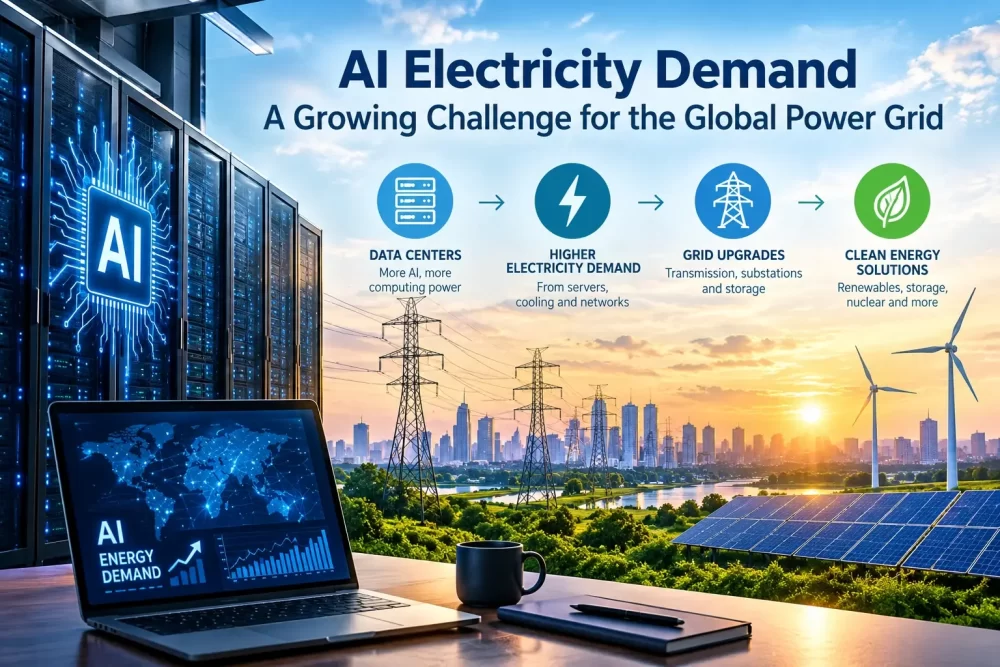
AI’s growing electricity needs require stronger power grids, energy storage and a reliable mix of clean energy sources.
The Role of Batteries and Energy Storage
Battery systems can store electricity when supply is plentiful and release it when demand rises or renewable generation falls. They can also provide short-duration backup and help stabilise parts of the grid.
Their usefulness depends on factors such as storage duration, cost, location and the length of any power shortfall. Batteries are not a complete substitute for every form of firm generation, but they can make renewable-heavy electricity systems more flexible.
Natural Gas and Nuclear Power
Natural gas may provide dispatchable electricity that can be increased when demand rises or renewable generation falls. Its use, however, involves fuel-price exposure and carbon emissions unless emissions are addressed through suitable technologies.
Nuclear power is another potential source of dependable low-carbon electricity. Existing nuclear plants can provide steady output, while new projects and advanced reactor designs may offer additional options over time. Construction timelines, cost, licensing and public acceptance remain important considerations.
The IEA expects data-centre electricity supply to draw on a mix of sources, including renewables and natural gas, with nuclear power becoming more important toward the end of the decade.
There is no single energy source that can resolve every challenge. The practical solution will vary by region, depending on available resources, infrastructure, costs and policy choices.
For further context, read the IEA’s analysis of energy supply for AI.
Could AI Increase Electricity Prices for Consumers?
The effect of AI on electricity prices is not the same everywhere. It depends on how quickly supply and grid capacity expand, how electricity markets are structured, and how the costs of new infrastructure are allocated.
Large data centres can help justify investment in generation and transmission that may benefit other users. They can also create new demand that improves the economics of some energy projects.
But there are risks if demand grows faster than infrastructure. When electricity supply is tight, wholesale prices can rise, and grid upgrades may increase costs that utilities seek to recover through customer bills.
The impact on household electricity prices depends on local rules and market conditions. It should not be assumed that every data centre will automatically raise residential bills, or that every new facility will reduce them.
Who Should Pay for Grid Upgrades?
A key policy question is how to allocate the cost of new infrastructure needed to connect large electricity users.
If a data centre requires a dedicated substation, transmission upgrade or other substantial investment, regulators and utilities need clear rules for deciding which costs should be borne by the operator and which may be shared across customers.
Transparent planning and fair cost allocation can help prevent ordinary consumers from paying an unreasonable share of infrastructure built primarily to serve large commercial users.
Can More Efficient AI Reduce Electricity Consumption?
Improving efficiency is one of the most important ways to manage rising AI electricity demand. Advances in chips, model design, cooling, software and data-centre operations can reduce the electricity needed to perform a given task.
Several approaches can help.
- More efficient processors: New hardware can deliver more computing performance per unit of electricity.
- Smaller and specialised models: Some applications can use smaller models instead of the largest available systems.
- Better cooling: Improved cooling designs can reduce the additional energy required to remove heat from computing equipment.
- Smarter workload scheduling: Non-urgent computing jobs can be shifted to times or locations where electricity is more available or cleaner.
- Improved utilisation: Data-centre operators can reduce waste by using computing equipment more effectively.
However, efficiency does not guarantee that total electricity use will fall. If AI becomes cheaper and easier to use, companies and individuals may use it more frequently. The resulting growth in activity can offset some of the savings achieved by more efficient technology.
This is sometimes described as a rebound effect: efficiency reduces the energy needed for an individual task, but increased use can push total demand higher.
The key measure is therefore not only how much more efficient AI becomes, but also how quickly the number and complexity of AI tasks grow.
AI Could Also Help Make Electricity Grids More Efficient
Although AI creates additional electricity demand, it can also help the energy sector operate more effectively.
Power companies and grid operators can use AI-supported tools to analyse weather forecasts, predict demand, detect equipment problems and identify opportunities to improve network performance.
Potential applications include:
- Forecasting electricity demand more accurately.
- Predicting wind and solar generation.
- Detecting faults and maintenance needs.
- Managing battery storage and flexible electricity loads.
- Helping balance supply and demand across the grid.
- Improving the operation of power plants and transmission networks.
These applications could help utilities integrate more renewable energy and reduce some forms of operational waste. Their real-world benefits depend on the quality of data, system design, implementation costs and whether operators can safely incorporate the tools into critical infrastructure.
AI is therefore both a new source of electricity demand and a potential tool for improving how electricity is produced, distributed and consumed.
Could Flexible Data Centres Ease Pressure on the Grid?
Not every computing task needs to be completed immediately. Some workloads, such as certain training runs, batch processing and non-urgent data analysis, can potentially be scheduled for periods when electricity is cheaper or more plentiful.
If data-centre operators coordinate with utilities, they may be able to reduce demand during peak periods or shift selected workloads to other times and locations.
This flexibility could help reduce pressure on the grid and limit the need for some expensive upgrades. It will not be suitable for every service: applications requiring immediate responses or uninterrupted operation may have little room to adjust their electricity use.
Flexible demand is most useful when operators can identify which workloads can safely be delayed, how much electricity can be shifted and what incentives make participation worthwhile.
The IEA has examined the potential for more flexible data-centre electricity use to help power systems manage rising demand. Read its Electricity 2026 analysis of demand for additional context.
What Governments, Utilities and Technology Companies Should Do
Managing AI electricity demand will require coordinated action rather than a single technological fix.
Governments and Regulators
Governments can improve long-term energy planning, streamline responsible infrastructure development and ensure that large electricity users face transparent connection and cost-allocation rules.
They can also support investment in transmission, storage and low-carbon generation while setting clear expectations for data-centre energy reporting.
Electricity Utilities
Utilities need better information about planned data-centre projects, their likely demand profiles and their expected connection dates. Coordinated planning can help avoid situations in which computing facilities are completed before the electricity network is ready.
Utilities can also develop demand-response programmes that reward operators for shifting suitable workloads or reducing electricity use during periods of grid stress.
Technology Companies and Data-Centre Operators
Technology companies can improve the energy efficiency of their models and hardware, choose locations with adequate infrastructure, and invest in credible clean-energy procurement.
They should also assess the full electricity requirements of a facility – including cooling and supporting infrastructure – rather than focusing only on processor efficiency.
Consumers and Businesses
Businesses adopting AI can consider whether a particular task requires a large model or whether a smaller, more efficient tool can deliver the same result. Users do not need to avoid AI altogether, but thoughtful deployment can reduce unnecessary computing.
The Bottom Line: AI Needs an Energy Strategy as Well as a Technology Strategy
Artificial intelligence could deliver substantial economic and social benefits, but its expansion depends on physical infrastructure that cannot be built instantly. Data centres require electricity, and their rapid growth is adding pressure to power systems in several parts of the world.
The IEA’s outlook points to a near-doubling of global data-centre electricity consumption between 2025 and 2030. The United States faces particularly strong data-centre growth, while India must accommodate new digital demand alongside broader economic and household electricity needs.
The outcome is not predetermined. More efficient AI, renewable energy, firm low-carbon generation, energy storage, better transmission networks and flexible data-centre operations can all help manage the challenge.
The most important question is not simply how much electricity AI will consume. It is whether governments, utilities and technology companies can coordinate investment quickly enough to deliver reliable, affordable and increasingly clean power.
AI’s future will depend on computing innovation – but also on whether the world can build an electricity system capable of supporting it.
Frequently Asked Questions
1. Why does artificial intelligence consume so much electricity?
AI relies on data centres containing specialised processors, storage, networking equipment and cooling systems. Training large models and running AI applications require computing power, while cooling and supporting infrastructure add to total electricity consumption.
2. How much electricity will data centres use by 2030?
The IEA’s 2026 central outlook estimates that global data-centre electricity consumption could rise from about 485 TWh in 2025 to around 950 TWh in 2030. Actual consumption will depend on AI adoption, efficiency improvements and the pace of infrastructure expansion.
3. Is AI responsible for all data-centre electricity demand?
No. Data centres also support cloud computing, online services, enterprise software, data storage and other digital activities. AI is an important and growing driver, but total data-centre electricity use should not be treated as AI-only consumption.
4. Could AI cause electricity shortages?
AI growth could contribute to local electricity constraints if data-centre demand increases faster than generation, transmission and distribution capacity. The risk depends on the location, timing of new demand and the ability of utilities to expand infrastructure.
5. Will AI increase electricity bills?
It could contribute to higher costs in some regions if demand outpaces supply or grid upgrades are passed on to consumers. The effect will depend on local electricity markets, infrastructure investment and the rules governing how costs are allocated.
6. Can renewable energy power AI data centres?
Yes. Renewable electricity can supply a substantial share of data-centre demand. Because solar and wind output varies, reliable supply may also require transmission, storage, flexible demand and other sources of firm electricity.
7. What can India do to manage AI electricity demand?
India can strengthen grid infrastructure, expand generation and storage, improve energy efficiency, plan data-centre locations carefully and ensure that new facilities have reliable power arrangements. These measures must complement the country’s wider electricity needs, including industry, cooling and household demand.
8. Can AI help reduce electricity consumption?
AI can improve demand forecasting, renewable-energy integration, equipment maintenance and grid operations. These benefits may help reduce waste, but they do not automatically offset the additional electricity used by expanding AI services.