Mumbai
India’s First Underground Bullet Train Station at BKC: Features, Depth and Progress

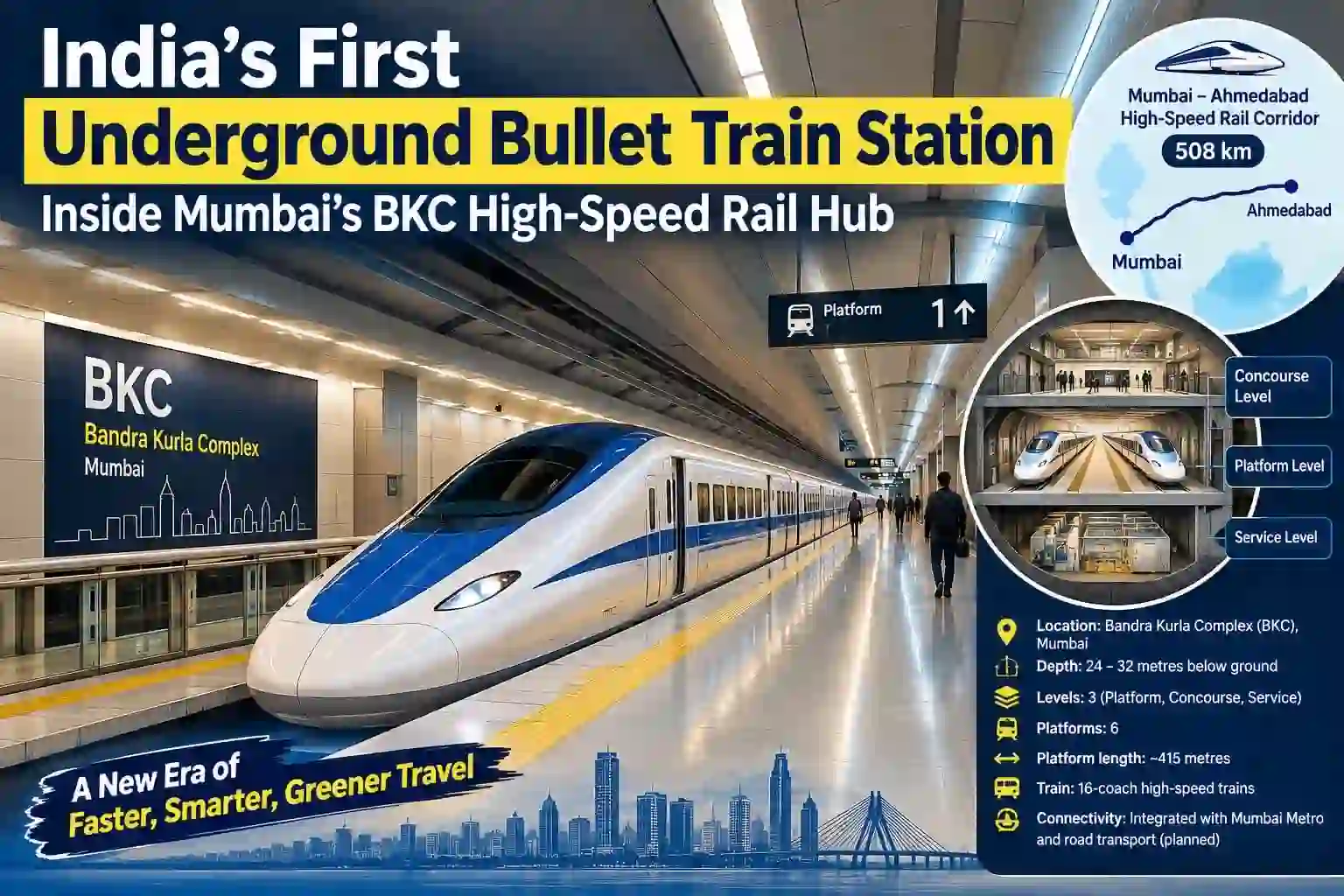
India’s first underground bullet train station is taking shape at Bandra Kurla Complex (BKC) in Mumbai, marking a major milestone in India’s high-speed rail infrastructure.
The BKC bullet train station is part of the 508-km Mumbai–Ahmedabad High Speed Rail (MAHSR) corridor, which will connect Mumbai and Ahmedabad through Maharashtra, Gujarat and the Union Territory of Dadra and Nagar Haveli. The Mumbai station is the only underground station on the Mumbai–Ahmedabad High Speed Rail corridor.
The station is being constructed beneath the densely developed BKC area and is planned with six platforms, three underground levels, metro and road connectivity, and dedicated skylights to bring natural light into the underground facility.
Key Facts About the BKC Bullet Train Station
| Feature | Details |
|---|---|
| Location | Bandra Kurla Complex, Mumbai |
| Project | Mumbai–Ahmedabad High Speed Rail |
| Corridor length | 508 km |
| Planned stations | 12 |
| Station type | Underground |
| Platforms | 6 |
| Platform length | Approximately 415 metres each |
| Platform depth | Approximately 24–26 metres |
| Maximum excavation depth | Approximately 32 metres |
| Station levels | 3 |
| Underground tunnel section | 21 km |
| TBM tunnel section | 16 km |
| Undersea tunnel | 7 km beneath Thane Creek |
The station specifications are based on information published by the National High Speed Rail Corporation Limited (NHSRCL).
BKC Bullet Train Station: What Makes It Different?
The Mumbai Bullet Train Station at BKC is different from the other planned stations on the Mumbai–Ahmedabad corridor because it is being built underground.
According to NHSRCL, the station will have six platforms, with each platform approximately 415 metres long. This is sufficient to accommodate a 16-coach bullet train.
The station will also have three levels comprising the platform, concourse and service floor.
Two entry and exit points are planned. One will provide access towards the nearby Metro Line 2B station, while another will connect towards the MTNL building.
The station is also being designed with passenger amenities and circulation space at the concourse and platform levels.
How Deep Is the BKC Bullet Train Station?
The BKC bullet train station is being constructed deep below ground level.
NHSRCL has stated that excavation is being carried out to approximately 32 metres below ground level, equivalent to roughly a 10-storey building.
The platform level has been described in NHSRCL’s project information as being planned at approximately 24 metres below ground level, while a later media brief described the platform depth as approximately 26 metres. The 32-metre level represents the deepest excavation/construction level.
The first concrete base slab for the station was cast on 30 November 2024 at a depth of approximately 32 metres.
That first slab was approximately 30 metres long, 20 metres wide and 3.5 metres deep. It used around 681 metric tonnes of high-grade steel reinforcement and 2,254 cubic metres of M60-grade concrete.
Why Is the BKC Bullet Train Station Underground?
The underground design allows the Mumbai–Ahmedabad High Speed Rail project to accommodate its station within the heavily developed Bandra Kurla Complex area.
Unlike most stations on the corridor, which are being constructed on elevated sections, the BKC station is being built below ground.
This makes the station an important engineering component of the Mumbai section of the bullet train corridor, particularly because the surrounding area contains major commercial developments, roads and existing urban infrastructure.
BKC Bullet Train Station Will Have Six Platforms
The station will have six platforms, each approximately 415 metres long.
The platform length has been planned to accommodate a 16-coach bullet train.
The station will have three underground levels:
- Platform level
- Concourse level
- Service floor
Passenger facilities, circulation areas and other amenities are planned at the station’s concourse and platform levels.
How Will Natural Light Reach the Underground Station?
One of the notable design features of the BKC bullet train station is the provision for natural lighting.
NHSRCL has planned dedicated skylight provisions so that natural light can reach parts of the underground station.
This is intended to make the underground passenger environment more comfortable while also reducing dependence on artificial lighting in suitable areas during daylight hours.
How Is the BKC Bullet Train Station Being Constructed?
The station is being constructed using the bottom-up construction method.
Under this approach, excavation begins from the ground level and construction progresses downwards, with structural and concrete work beginning from the foundation.
The first base slab was cast in November 2024 at approximately 32 metres below ground level. It was the first of 69 slabs planned for the station and forms the deepest construction level.
The station’s construction involves extensive excavation, reinforced concrete structures, waterproofing and temperature-controlled concrete operations.
NHSRCL’s May 2025 media brief reported that approximately 76% of excavation had been completed at that stage, while base slab casting was progressing.
Mumbai Bullet Train Tunnel: 21-Km Underground Section
The BKC station is also connected to one of the most technically challenging sections of the Mumbai–Ahmedabad bullet train project: a 21-km underground tunnel between BKC and Shilphata in Maharashtra.
Of this 21-km underground section:
- 16 km is being constructed using Tunnel Boring Machines (TBMs).
- 5 km is being constructed using the New Austrian Tunnelling Method (NATM).
- The tunnel includes a 7-km undersea section beneath Thane Creek.
The tunnel is being constructed as a single tube designed to accommodate both tracks.
India’s First Undersea Rail Tunnel Beneath Thane Creek
One of the most significant engineering features of the Mumbai section is the 7-km undersea tunnel beneath Thane Creek.
According to NHSRCL, this will be India’s first undersea tunnel for a rail corridor.
The undersea section forms part of a 10-km stretch being constructed between the Sawli area near Ghansoli and Vikhroli.
The tunnel is being constructed using large Tunnel Boring Machines designed specifically for the challenging underground conditions.
Mumbai-Ahmedabad Bullet Train Project: Latest 2026 Updates
The Mumbai–Ahmedabad bullet train project has reached several important construction milestones during 2026.
In March 2026, the Ministry of Railways reported the following overall project progress:
- 430 km of piers
- 341 km of girders
- 174 km of track bed
- 153 km of overhead electrification masts
At BKC, the underground station’s foundation work was reported as almost complete, with base slab work underway.
First TBM Starts Excavation from Vikhroli
On 5 July 2026, the first Tunnel Boring Machine began excavation from the Vikhroli shaft towards the under-construction BKC bullet train station.
This TBM is working on part of the 16-km section that will be constructed using TBMs. The machine’s initial drive from Vikhroli towards BKC covers approximately 6 km.
Second TBM Starts Work from Sawli
On 18 July 2026, the second TBM began tunnelling from Sawli near Ghansoli towards Vikhroli.
The second machine is working on the other side of the underground section and forms part of the construction of the 21-km tunnel.
NHSRCL stated that the 7-km undersea section beneath Thane Creek is part of the 10-km stretch being excavated in this area.
These TBM operations represent an important phase in the construction of the Mumbai underground section of India’s first bullet train corridor.
What Will the BKC Bullet Train Station Mean for Mumbai?
The BKC bullet train station is being developed as an important high-speed rail connection for Mumbai.
Its location at Bandra Kurla Complex places it within one of Mumbai’s major commercial districts, while planned connectivity with Metro Line 2B and road networks is intended to improve access to the station.
The underground design also allows the project to integrate a high-speed rail station into a densely developed urban environment without constructing a large elevated station structure at ground level.
India’s High-Speed Rail Ambition
The Mumbai–Ahmedabad High Speed Rail project spans 508 km and has 12 planned stations: Mumbai, Thane, Virar, Boisar, Vapi, Bilimora, Surat, Bharuch, Vadodara, Anand, Ahmedabad and Sabarmati.
The project is being developed as India’s first high-speed rail corridor and incorporates technologies and construction practices associated with Japan’s Shinkansen system.
The BKC station and the Mumbai underground tunnel are among the project’s most technically distinctive components, combining deep underground construction, large-scale TBM tunnelling and an undersea rail tunnel beneath Thane Creek.
FAQs About the BKC Bullet Train Station
1. Which is India’s first underground bullet train station?
The Mumbai Bullet Train Station at Bandra Kurla Complex (BKC) is India’s first underground bullet train station and the only underground station on the Mumbai–Ahmedabad High Speed Rail corridor.
2. How deep is the BKC bullet train station?
The station is being excavated to approximately 32 metres below ground level. The platform is planned several metres above the deepest construction level, with NHSRCL project documents giving approximately 24–26 metres depending on the project information version.
3. How many platforms will the BKC bullet train station have?
The BKC bullet train station will have six platforms, each approximately 415 metres long and designed to accommodate 16-coach bullet trains.
4. Why is the Mumbai bullet train station underground?
The BKC station is being constructed underground as part of the project’s design for the densely developed Bandra Kurla Complex area. It is the only underground station on the Mumbai–Ahmedabad High Speed Rail corridor.
5. Is BKC the only underground station on the Mumbai-Ahmedabad bullet train corridor?
Yes. NHSRCL describes the Mumbai station at BKC as the only underground station on the Mumbai–Ahmedabad High Speed Rail corridor.
6. Does India’s bullet train project have an undersea tunnel?
Yes. The Mumbai–Ahmedabad bullet train project includes a 7-km undersea rail tunnel beneath Thane Creek in Maharashtra. NHSRCL describes it as India’s first undersea tunnel for a rail corridor.
7. How long is the underground tunnel for the Mumbai bullet train?
The underground tunnel section between BKC and Shilphata is approximately 21 km long. About 16 km is being constructed using TBMs and the remaining 5 km using NATM.
8. How many stations are planned on the Mumbai-Ahmedabad bullet train corridor?
The 508-km Mumbai–Ahmedabad High Speed Rail corridor has 12 planned stations, from Mumbai to Sabarmati via Maharashtra, Gujarat and the Union Territory of Dadra and Nagar Haveli.
Conclusion
The BKC bullet train station is one of the most distinctive components of India’s Mumbai–Ahmedabad High Speed Rail project.
Located underground at Bandra Kurla Complex, the station will feature six long platforms, three levels, metro and road connectivity and provisions for natural lighting through skylights.
Beyond the station itself, the Mumbai section includes a 21-km underground tunnel and a 7-km undersea rail tunnel beneath Thane Creek. With TBM excavation beginning from Vikhroli and Sawli in July 2026, the underground portion of the project has entered another significant construction phase.
The BKC station and its associated underground infrastructure therefore represent a major engineering component of India’s first high-speed rail corridor.