Cars
EV vs Hybrid vs Gasoline Cars: Which Is Best for Americans in 2026?

Published
11 hours agoon
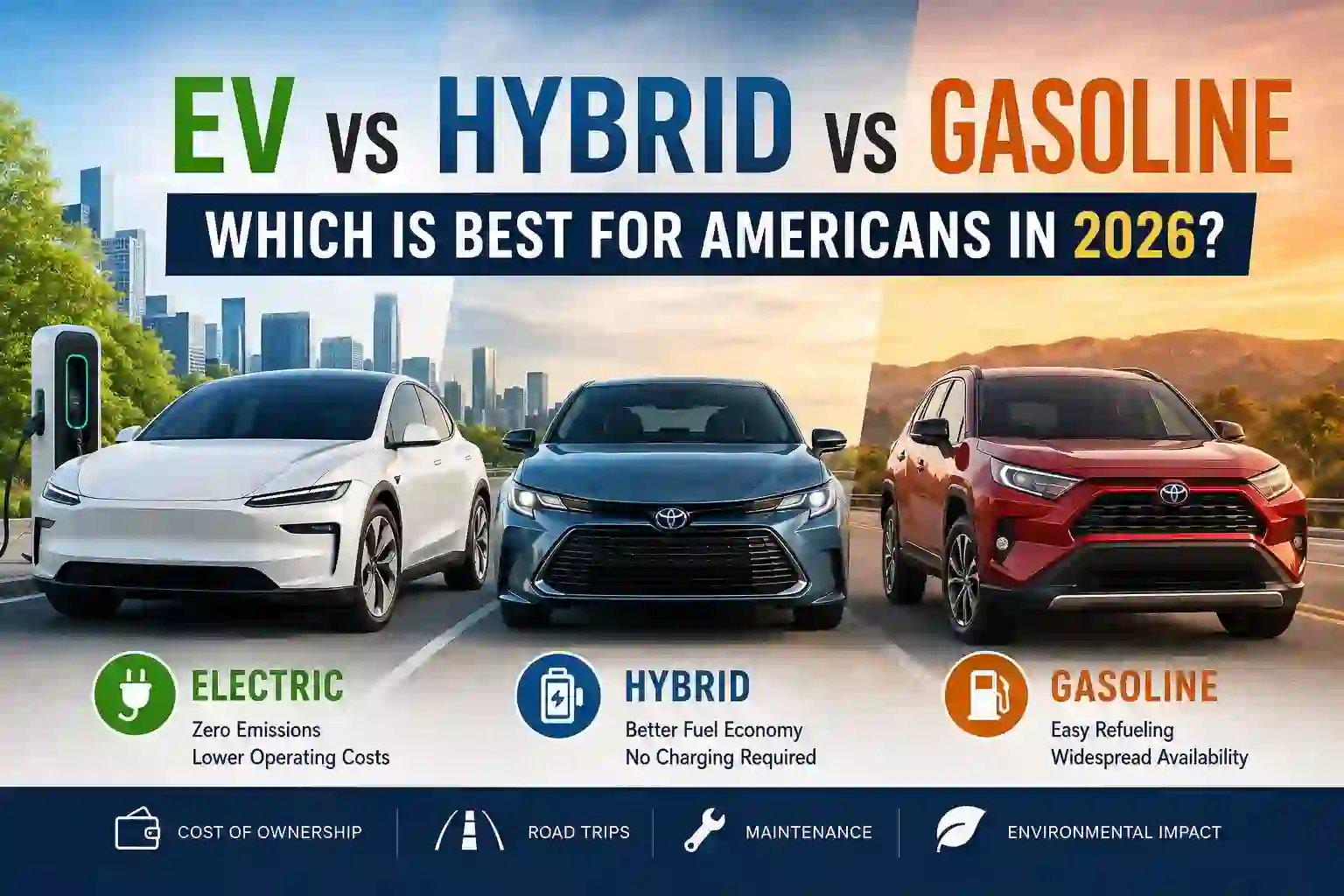
Table of Contents
ToggleEV vs Hybrid vs Gasoline is one of the most important comparisons for Americans shopping for a new car in 2026. The right choice depends on where you drive, how many miles you travel, whether you can charge at home, how often you take road trips, your fuel and electricity costs, and how long you plan to keep the vehicle.
Electric vehicles (EVs), hybrid cars, and gasoline-powered vehicles each have different advantages. EVs eliminate tailpipe emissions and can have lower routine maintenance requirements. Hybrids combine a gasoline engine with electric assistance without requiring regular plug-in charging. Gasoline vehicles continue to offer widespread refueling infrastructure and a broad selection of cars, SUVs and trucks.
The financial equation has also changed in 2026. The federal New Clean Vehicle Credit and Previously-Owned Clean Vehicle Credit are no longer available for vehicles acquired after September 30, 2025, according to the Internal Revenue Service (IRS).
So, which is better: an EV, hybrid or gasoline car?
There is no universal winner. The best powertrain depends on your driving pattern.
Quick answer
| Driver situation | EV | Hybrid | Gasoline |
|---|---|---|---|
| Home charging available | Excellent fit | Good | Good |
| Mostly city driving | Excellent fit | Excellent fit | Good |
| Frequent road trips | Good with planning | Very practical | Very practical |
| No home charging | More challenging | Very practical | Very practical |
| Lowest routine powertrain maintenance | Strong advantage | Moderate | Moderate |
| Heavy towing | Depends on vehicle | Depends on vehicle | Many strong options |
| Zero tailpipe emissions | Yes | No | No |
| Quick refueling | No | Yes | Yes |
| Predictable short commute | Excellent fit | Excellent fit | Good |
This table is a general guide. Individual vehicle specifications, prices, efficiency, charging speed, towing capacity, insurance and local energy costs can change the calculation.
EV vs Hybrid vs Gasoline: What’s the Difference?
Before comparing costs and ownership, it helps to understand how the three powertrains work.
Electric vehicles (EVs)
A battery-electric vehicle, commonly called a BEV, uses a battery pack and electric motor rather than a gasoline engine. The battery is charged from an external electricity source and can also recover energy through regenerative braking.
EVs produce no direct tailpipe emissions while driving. However, electricity generation and battery manufacturing can still create emissions, so the overall environmental impact depends on factors including the electricity source and vehicle production.
Hybrid vehicles
A conventional hybrid, or HEV, combines a gasoline engine with an electric motor and battery. Unlike a plug-in hybrid (PHEV) or fully electric vehicle (EV), a conventional hybrid generally does not need to be plugged into an external charger. Its battery is recharged through regenerative braking and energy produced by the gasoline engine.
This allows a hybrid to improve fuel efficiency while retaining the familiar experience of gasoline refueling.
Gasoline vehicles
Gasoline vehicles use an internal-combustion engine powered by gasoline. They remain widely available across vehicle categories, including cars, SUVs, pickups and heavy-duty vehicles.
For many drivers, gasoline vehicles continue to offer a familiar combination of quick refueling, widespread fuel availability and a large selection of models.
Electric Cars: Best for Drivers Who Can Charge at Home
For many drivers, an EV can be an attractive choice when reliable home or workplace charging is available.
An EV eliminates the need for routine gasoline refueling and has a simpler electric powertrain than a conventional gasoline vehicle. The U.S. Department of Energy’s Alternative Fuels Data Center notes that all-electric vehicles have fewer moving parts and fluids requiring regular maintenance than conventional vehicles.
For a driver with a predictable commute, the ability to charge overnight can make daily EV ownership relatively convenient.
Lower Routine Maintenance
One of the major advantages of an EV is its simpler powertrain.
There is no conventional engine oil to replace, and an EV does not have many of the engine-related components found in a gasoline vehicle.
That does not mean EVs are maintenance-free.
Owners still need to maintain:
- Tires
- Brakes
- Suspension components
- Windshield wipers
- Cooling systems
- Cabin filters
- Other vehicle-specific components
Regenerative braking can also reduce conventional brake wear. The Department of Energy says all-electric vehicles generally require less maintenance because they have fewer moving parts, fewer fluids requiring routine maintenance and reduced brake wear.
EV Charging Is the Biggest Ownership Question
For an EV buyer in 2026, charging access may be more important than the vehicle’s advertised range.
The Department of Energy says most EV drivers charge at home, typically using Level 1 or Level 2 equipment. Level 2 charging can provide faster charging and may be useful for drivers with longer commutes or larger batteries.
This makes the following questions important before buying an EV:
- Do you have a garage or dedicated parking space?
- Can you install a home charger?
- Does your apartment or condominium provide charging?
- Is workplace charging available?
- How close are public fast chargers?
- What does electricity cost in your area?
- How frequently do you take long road trips?
Public charging can supplement home charging, particularly for long-distance travel. The Department of Energy identifies Level 2 and DC fast charging as common forms of public charging.
U.S. Department of Energy: EV charging at home
For related reading, see our guide to building an affordable EV ecosystem.
EV Prices and Total Ownership Cost in 2026
The financial case for EVs changed significantly after the federal clean-vehicle credits ended.
The IRS currently states that the New Clean Vehicle Credit and Previously-Owned Clean Vehicle Credit are unavailable for vehicles acquired after September 30, 2025.
That means buyers should not assume a new EV purchased in 2026 will qualify for the former federal vehicle purchase credit.
However, purchase price alone does not determine ownership cost.
An EV’s total cost can include:
- Purchase price
- Financing
- Electricity
- Insurance
- Tires
- Maintenance
- Registration and taxes
- Depreciation
- Home charging equipment
- Public charging
The Department of Energy notes that EV charging costs depend on electricity prices, vehicle efficiency and charging circumstances.
Who should consider an EV?
An EV may be particularly suitable for drivers who:
- Can charge at home or work
- Have predictable daily driving
- Drive primarily in urban or suburban areas
- Want zero direct tailpipe emissions
- Want to reduce routine powertrain maintenance
- Are comfortable planning charging for longer trips
Hybrid Cars: A Practical Middle Ground
Hybrid vehicles occupy a unique position between conventional gasoline cars and fully electric vehicles.
A conventional hybrid uses both an internal-combustion engine and an electric motor. Its battery is charged through regenerative braking and the engine rather than through a conventional plug-in connection.
That means drivers can benefit from electric assistance without changing the way they refuel.
Why Are Hybrids Popular With Many Drivers?
The biggest advantage of a conventional hybrid is convenience.
You can drive to a gas station, refuel and continue your trip without waiting for the battery to recharge.
At the same time, the electric motor can assist the gasoline engine, and regenerative braking can recover energy that would otherwise be lost.
Hybrid systems can be particularly useful in stop-and-go driving because the vehicle can use electric assistance and reduce engine idling.
Hybrids Do Not Require Home Charging
This is one of the clearest differences between a conventional hybrid and an EV.
A conventional hybrid does not require:
- A home charging station
- A dedicated garage outlet
- Public charging
- Charging stops during road trips
That makes hybrids particularly attractive to people who live in apartments, park on the street or simply do not want to plan their driving around charging.
Hybrid Maintenance
A hybrid still has an internal-combustion engine, so its maintenance needs are generally closer to those of a conventional gasoline vehicle than an all-electric vehicle.
The Department of Energy says hybrid and plug-in hybrid maintenance requirements are similar to conventional vehicles because they still use internal-combustion engines.
The exact maintenance schedule depends on the vehicle.
Who Should Consider a Hybrid?
A hybrid may fit drivers who:
- Want better fuel economy
- Drive frequently in urban traffic
- Take regular road trips
- Do not have home charging
- Want electrification without changing refueling habits
- Want to reduce gasoline consumption without buying a fully electric vehicle
Gasoline Cars: Still Practical for Many Americans
Gasoline vehicles remain an important part of the U.S. automotive market.
Their biggest advantages are familiar:
Fill the tank, start the engine and drive.
Gasoline infrastructure is widespread throughout the United States, making refueling convenient for drivers traveling long distances or through areas with limited EV charging.
Excellent for Long Road Trips
For frequent road travelers, gasoline vehicles remain highly convenient.
Refueling typically takes only a few minutes, and drivers do not need to plan a route around charging stations.
This can be particularly important for:
- Rural drivers
- Long-distance commuters
- Frequent highway travelers
- Drivers who tow
- People who travel through areas with limited charging infrastructure
The Department of Energy notes that charging stations are not yet as common as gas stations and recommends EV drivers plan charging stops for longer journeys.
More Vehicle Choices
Gasoline vehicles remain available across a broad range of categories.
Buyers can choose among:
- Compact cars
- Sedans
- SUVs
- Pickup trucks
- Sports cars
- Full-size trucks
- Heavy-duty vehicles
This broad selection can be important for consumers who need specific towing, payload or off-road capabilities.
Fuel Costs Can Be a Disadvantage
Gasoline is an ongoing operating expense.
Drivers who travel many miles each year can spend considerably more on fuel than drivers whose vehicles use less gasoline or electricity.
Fuel prices can also vary by region and over time.
For that reason, high-mileage drivers should compare the estimated annual fuel or electricity cost rather than looking only at the sticker price.
Gasoline Vehicle Maintenance
Gasoline engines have more mechanical components that require routine servicing.
Depending on the vehicle, maintenance can include:
- Engine oil and filter changes
- Spark plugs
- Transmission service
- Exhaust components
- Engine fluids
- Belts and related components
That does not mean gasoline vehicles are inherently unreliable. Modern gasoline vehicles can provide many years of service when maintained according to the manufacturer’s recommendations.
Who should consider a gasoline vehicle?
A gasoline vehicle may make sense for drivers who:
- Frequently travel long distances
- Want fast and familiar refueling
- Live in areas with limited EV charging
- Need heavy towing capability
- Want the widest possible selection of vehicles
- Prefer conventional vehicle technology
EV vs Hybrid vs Gasoline: Which Is Cheapest to Own in 2026?
There is no universal answer.
The cheapest vehicle to buy is not necessarily the cheapest vehicle to own.
A proper comparison should consider:
- Purchase price
- Financing cost
- Fuel or electricity
- Insurance
- Maintenance
- Tires
- Charging equipment
- Registration and taxes
- Depreciation
- Expected ownership period
For example, an EV with a higher purchase price could have lower energy and routine maintenance costs. A hybrid could cost more than a comparable gasoline vehicle but use less gasoline. A gasoline vehicle could have a lower upfront price but higher fuel expenses over several years.
The U.S. Department of Energy provides tools and information for comparing alternative-fuel vehicle operating costs, while the EPA’s fuel-economy resources provide model-specific efficiency information.
U.S. Department of Energy Alternative Fuels Data Center
EPA Fuel Economy and EV Range Testing
What Happened to the Federal EV Tax Credit?
This is one of the most important changes for Americans shopping for an EV in 2026.
The IRS says the New Clean Vehicle Credit, Previously-Owned Clean Vehicle Credit and Qualified Commercial Clean Vehicle Credit are not available for vehicles acquired after September 30, 2025.
There is an important technical distinction: the IRS says a vehicle acquired by September 30, 2025 under the applicable rules could potentially remain eligible even if it was placed in service later.
For a normal consumer shopping for a new vehicle in late 2026, however, these former federal purchase credits should not be treated as an available incentive.
What about an EV charger tax credit?
The federal Alternative Fuel Vehicle Refueling Property Credit also changed.
The IRS states that the §30C credit for qualified charging/refueling property was available for eligible property placed in service through June 30, 2026.
Therefore, an EV buyer in late 2026 should not assume that a newly installed home charger qualifies for the former federal credit.
State, local, utility and other programs can have different rules, so buyers should verify current eligibility directly with the relevant program before including an incentive in their purchase calculations.
EV vs Hybrid vs Gasoline for Different Types of Drivers
The best powertrain can change dramatically depending on how you actually use your vehicle.
If You Mostly Drive in a City
An EV or hybrid can be particularly attractive.
EVs can benefit from regenerative braking and are generally very efficient in city driving. The Department of Energy notes that city driving can maximize regenerative-braking benefits.
A hybrid can also perform well in stop-and-go traffic while retaining gasoline refueling.
Best fit: EV if charging is convenient; hybrid if it is not.
If You Drive 20 to 30 Miles Every Day
A predictable short commute can be well suited to an EV.
If you can charge at home overnight, you may rarely need public charging for normal commuting.
A hybrid can provide similar convenience without requiring charging.
Best fit: EV with home charging; hybrid without it.
If You Take Frequent Road Trips
Gasoline and hybrid vehicles offer simple refueling.
EV road trips are increasingly practical, but they require more attention to charging locations, charging speeds and route planning.
The Department of Energy recommends planning charging stops for longer EV trips because public charging is not yet as ubiquitous as gasoline stations.
Best fit: Hybrid or gasoline for maximum refueling convenience; EV for drivers comfortable planning charging.
If You Live in an Apartment
Charging access should be one of your first questions.
An apartment resident with reliable workplace or building charging may still find an EV practical.
But if charging is difficult or unavailable, a conventional hybrid eliminates the need for a charging setup.
Best fit: Hybrid when reliable charging is unavailable.
If You Drive Very High Annual Mileage
High-mileage drivers should focus heavily on operating cost.
Calculate:
Annual energy cost = annual miles ÷ vehicle efficiency × energy price
For gasoline vehicles, compare miles per gallon and local gasoline prices.
For EVs, compare kilowatt-hours per 100 miles with your electricity rate.
The Department of Energy explains that EV charging cost depends on electricity price and vehicle efficiency.
Best fit: Depends on local fuel/electricity prices, vehicle efficiency and charging access.
If You Tow Frequently
Do not choose a powertrain based only on fuel economy.
Instead, compare:
- Maximum towing capacity
- Payload
- Trailer weight
- Hitch requirements
- Battery/range impact
- Charging availability
- Highway range
- Vehicle size
- Manufacturer towing recommendations
Gasoline-powered trucks and SUVs remain widely available for heavy-duty applications, while electric and hybrid trucks are expanding their capabilities.
Best fit: The specific vehicle that meets the towing requirement safely and comfortably.
EV vs Hybrid vs Gasoline: What About Resale Value?
Resale value is difficult to predict several years into the future because vehicle technology, incentives, battery technology, consumer demand and new-model pricing continue to change.
EV buyers should pay particular attention to:
- Battery warranty
- Battery health
- Charging speed
- Driving range
- Model-year changes
- Depreciation
- Used-EV demand
Hybrid buyers may benefit from a powertrain that requires no dedicated charging infrastructure.
Gasoline vehicles have a large established used-vehicle market, but resale performance varies substantially by model, mileage, condition, drivetrain and market demand.
Instead of assuming one powertrain will always have the highest resale value, buyers should compare the specific vehicles they are considering.
EV vs Hybrid vs Gasoline: Which Is Better for the Environment?
From a tailpipe-emissions perspective, EVs have the clearest advantage because battery-electric vehicles produce no direct tailpipe emissions while driving.
Hybrids still use gasoline, so they continue to produce tailpipe emissions.
Gasoline vehicles also produce direct tailpipe emissions from fuel combustion.
However, comparing environmental impact requires more than looking at the tailpipe.
An EV’s broader environmental footprint includes factors such as:
- Battery manufacturing
- Electricity generation
- Vehicle manufacturing
- Charging
- Battery recycling and end-of-life
The EPA notes that EVs can have lower overall greenhouse-gas emissions than comparable gasoline vehicles even when electricity-generation emissions are considered, although the result varies with the electricity mix and other factors.
EV vs Hybrid vs Gasoline: Pros and Cons
| Powertrain | Main advantages | Main disadvantages |
|---|---|---|
| EV | No tailpipe emissions, lower routine maintenance, home charging, quiet operation | Charging access, road-trip planning, upfront price can be higher |
| Hybrid | Good fuel economy, no regular charging, easy road trips, familiar refueling | Still uses gasoline, more complex than a conventional EV |
| Gasoline | Fast refueling, broad vehicle selection, strong road-trip infrastructure | Fuel costs, more routine engine maintenance, tailpipe emissions |
Which Powertrain Is Best for Americans in 2026?
The answer depends on the driver.
Choose an EV if:
- You can charge at home or work.
- Your daily driving is relatively predictable.
- You want zero direct tailpipe emissions.
- You are comfortable planning longer trips around charging.
- The vehicle’s total cost works for your budget.
Choose a hybrid if:
- You want better fuel economy without charging.
- You regularly drive in city traffic.
- You take road trips.
- You live somewhere without convenient EV charging.
- You want an electrified powertrain without changing your refueling habits.
Choose a gasoline vehicle if:
- You prioritize fast refueling.
- You frequently drive long distances.
- You live in an area with limited charging infrastructure.
- You need specific towing or hauling capabilities.
- You want the broadest selection of conventional vehicles.
A Simple 2026 Car-Buying Decision Framework
Before choosing between an EV, hybrid and gasoline vehicle, answer these seven questions:
1. Where do I park overnight?
If you have dedicated parking and charging access, an EV becomes easier to live with.
2. How many miles do I drive each day?
Predictable daily mileage can make EV ownership particularly convenient.
3. How often do I take road trips?
Frequent long-distance travel increases the importance of charging and refueling convenience.
4. What does electricity cost where I live?
Local electricity rates can significantly affect EV operating costs.
5. What does gasoline cost where I live?
Fuel prices directly affect the long-term cost of gasoline and hybrid vehicles.
6. Do I need to tow or haul heavy loads?
Look at the specifications of the exact vehicle rather than assuming one powertrain is always better.
7. How long will I keep the vehicle?
A buyer keeping a car for eight or 10 years should evaluate long-term operating costs rather than only the purchase price.
Frequently Asked Questions
Is an EV cheaper than a hybrid in 2026?
Not necessarily. An EV may have lower energy and routine maintenance costs, but purchase price, insurance, electricity rates, depreciation and charging costs all affect total ownership cost. A hybrid may be more economical for a driver who lacks inexpensive home charging.
Is a hybrid better than an EV for long road trips?
A conventional hybrid can be more convenient for frequent road trips because it can refuel at gasoline stations without charging stops. An EV can also be suitable for road trips, but charging locations and charging time need to be considered.
Is a hybrid cheaper than a gasoline car?
It depends on the specific vehicles and how much you drive. A hybrid may cost more to purchase but consume less gasoline. The correct comparison is the total cost of ownership over the period you expect to keep the vehicle.
Do EVs require maintenance?
Yes. EVs still require tire, brake, suspension, cooling-system and other maintenance. However, the Department of Energy says all-electric vehicles generally require less maintenance than conventional vehicles because they have fewer moving parts and fewer fluids requiring regular service.
Do hybrid cars need to be plugged in?
A conventional hybrid generally does not need to be plugged in. Its battery is charged through regenerative braking and the internal-combustion engine. Plug-in hybrids are different because they can be charged from an external electricity source.
Is the federal EV tax credit available in 2026?
For vehicles acquired after September 30, 2025, the federal New Clean Vehicle Credit and Previously-Owned Clean Vehicle Credit are no longer available under the current IRS rules.
Is there still a federal tax credit for installing an EV charger?
The federal §30C Alternative Fuel Vehicle Refueling Property Credit was extended only through June 30, 2026 for eligible property. A charger placed in service after June 30, 2026 should not be assumed to qualify for that federal credit.
Which is best for city driving: EV, hybrid or gasoline?
An EV or hybrid can be particularly well suited to city driving. EVs benefit from regenerative braking and electric propulsion, while hybrids can use electric assistance in stop-and-go traffic. The better choice depends largely on charging access and total ownership cost.
Which is best for someone who lives in an apartment?
A hybrid can be especially convenient when an apartment does not provide reliable EV charging. An EV can still work well if the building, workplace or nearby public network provides convenient charging.
Which is best for towing?
The answer depends on the exact vehicle, trailer and towing requirements. Buyers should compare rated towing capacity, payload, range, charging or refueling requirements and manufacturer specifications rather than choosing solely by powertrain.
Final Takeaway: EV vs Hybrid vs Gasoline in 2026
EV vs Hybrid vs Gasoline is not a one-size-fits-all decision.
An EV can be an excellent fit for drivers with convenient charging, predictable daily mileage and an interest in zero direct tailpipe emissions and lower routine powertrain maintenance.
A hybrid can be a practical choice for drivers who want improved fuel efficiency without relying on charging infrastructure. It is particularly convenient for people who combine city driving with frequent road trips.
A gasoline vehicle remains highly practical for drivers who prioritize fast refueling, widespread fuel availability, heavy towing capability or a broad selection of models.
The smartest way to choose in 2026 is to compare the specific vehicles, not just the powertrains.
Look at the purchase price, financing, fuel or electricity cost, insurance, maintenance, charging requirements, depreciation, warranty coverage and your actual driving habits.
In other words, the best car is the one whose powertrain, cost and infrastructure match the way you really drive.
Additional Reading and Sources

Sushree Mishra is a content and social media professional with a keen interest in digital media, technology, business, and current affairs. She focuses on creating engaging, informative content that connects ideas with readers. Her work reflects a passion for clear storytelling, digital communication, and emerging trends shaping the modern world.