Business
Amazon’s $48 Billion India Investment: Why AI, Cloud and E-Commerce Are Driving the Expansion

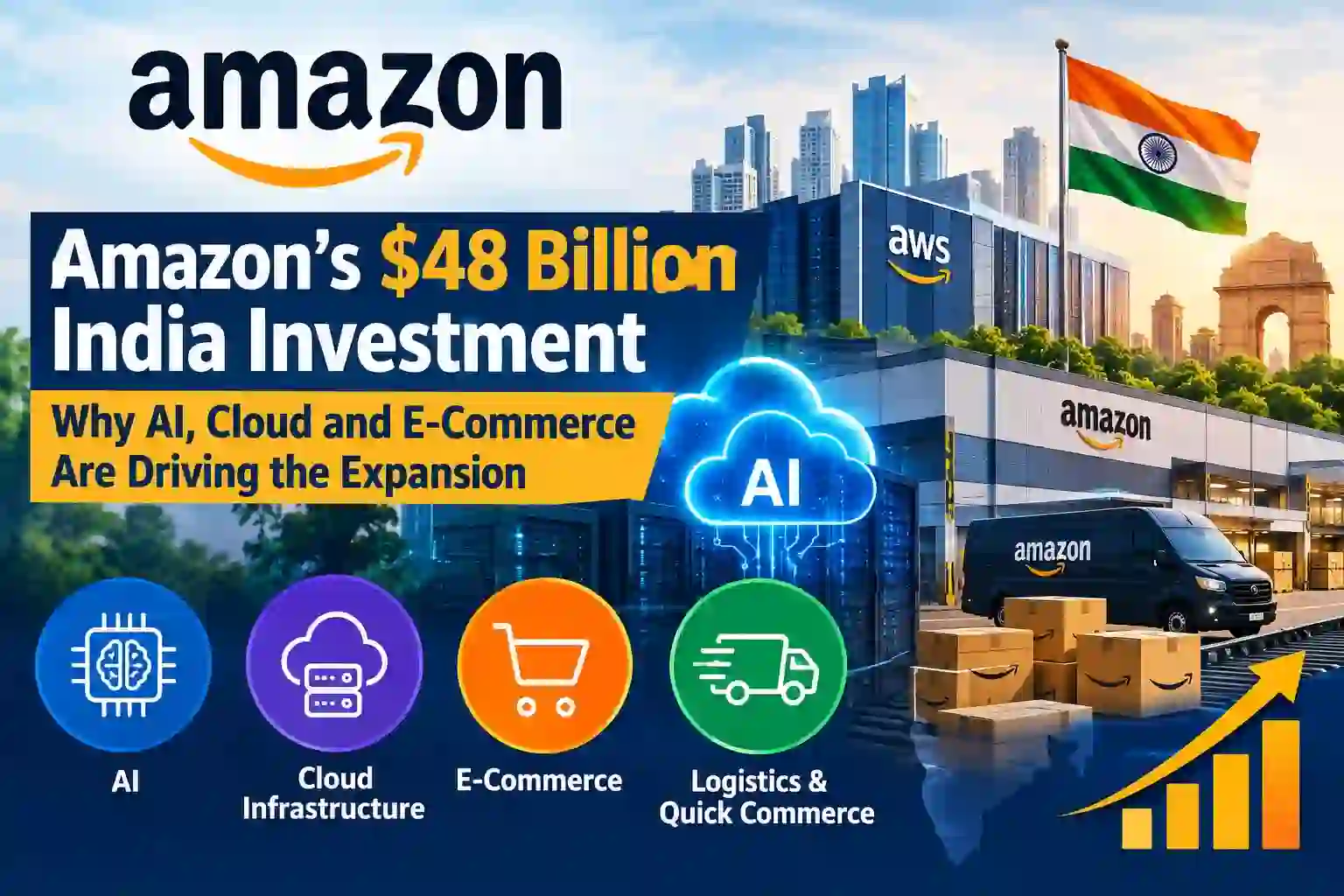
Amazon is significantly expanding its India strategy with a planned $48 billion investment across its businesses between 2026 and 2030, strengthening its presence in artificial intelligence (AI), cloud computing, e-commerce, logistics and digital services.
The commitment includes an additional $13 billion investment in AI and cloud infrastructure, taking Amazon’s total planned AI and cloud investment in India to more than $21 billion between 2026 and 2030. Amazon says the expansion will increase AWS data-centre capacity in Mumbai and Hyderabad and provide startups, enterprises and government organisations with access to AI chips, cloud services and developer tools.
Amazon’s broader India expansion also includes new fulfilment centres, last-mile delivery stations, quick-commerce infrastructure and initiatives aimed at small businesses, exports, AI education and employment.
Key Takeaways
- Amazon plans to invest $48 billion in India between 2026 and 2030.
- The company says more than $21 billion of its planned investment during this period will support AI and cloud infrastructure.
- AWS plans to expand its data-centre capacity in Mumbai and Hyderabad.
- Amazon plans to expand its fulfilment and last-mile delivery network across India.
- Amazon Now is being expanded to more than 300 cities.
- Amazon says it has already digitised 12 million small businesses and enabled more than $20 billion in cumulative e-commerce exports.
- By 2030, Amazon aims to support 3.8 million jobs, enable $80 billion in cumulative e-commerce exports and extend AI benefits to 15 million small businesses.
What Is Amazon’s $48 Billion India Investment?
Amazon’s $48 billion India investment refers to its planned spending across its Indian businesses between 2026 and 2030.
The latest commitment builds on the $35 billion investment plan announced in December 2025. In June 2026, Amazon announced an additional $13 billion, taking the total planned investment to $48 billion through 2030. Amazon says its cumulative investment in India from 2010 through 2030 is expected to exceed $88 billion.
The investment is not limited to e-commerce. It covers a broader ecosystem involving:
- Artificial intelligence
- Cloud computing
- Data centres
- E-commerce
- Logistics
- Quick commerce
- Small-business digitisation
- Exports
- Technology skills
- Digital services
This makes the announcement significant not simply because of its size, but because of the range of industries and infrastructure it covers.
How Much Is Amazon Investing in AI and Cloud Infrastructure in India?
Amazon says it plans to invest more than $21 billion in AI and cloud infrastructure in India between 2026 and 2030.
The investment will support the expansion of Amazon Web Services (AWS) infrastructure, including data-centre capacity in Mumbai and Hyderabad.
According to Amazon, the expanded infrastructure will give Indian startups, enterprises and government organisations access to technologies including custom AI chips, managed AI services, cloud computing and developer tools.
This is important because modern AI development increasingly depends on physical computing infrastructure.
Training and running sophisticated AI models requires:
- High-performance processors and AI accelerators
- Large-scale data storage
- High-speed networking
- Cloud computing capacity
- Data centres
- Electricity and cooling infrastructure
- AI development platforms and software
As AI adoption expands in India, demand for these underlying resources is also expected to increase.
Why Is AI at the Centre of Amazon’s India Expansion?
Artificial intelligence is becoming one of the most important components of Amazon’s India strategy.
AWS provides the infrastructure on which companies can build, train and deploy AI applications. Amazon says hundreds of thousands of Indian enterprises, startups and government agencies are already using AWS for workloads including AI.
Amazon’s investment therefore extends beyond consumer-facing AI applications.
It is also about building the computing infrastructure required to develop and operate AI systems.
This creates potential opportunities for India’s broader technology ecosystem.
For example, startups developing AI applications could use cloud infrastructure without having to build their own large-scale data centres. Enterprises could increase their use of AI-powered applications, while developers could gain access to managed AI services and specialised computing resources.
The expansion also connects with India’s broader push toward artificial intelligence and digital infrastructure.
Related reading: India’s AI ecosystem and emerging artificial intelligence developments
Amazon’s Cloud Infrastructure Expansion in Mumbai and Hyderabad
Mumbai and Hyderabad are central to Amazon’s cloud infrastructure expansion in India.
AWS already operates infrastructure in the country, and Amazon is increasing its investment in both regions to support rising demand for cloud and AI services.
In Hyderabad, AWS has broken ground on additional data-centre infrastructure. Amazon says it had invested more than $1.3 billion in its Hyderabad AWS Region by the end of 2025, with substantially larger investment planned through 2030.
The expanded infrastructure can support:
- AI model development
- Machine learning
- Data analytics
- Software development
- Cloud-native applications
- Enterprise technology
- Government digital services
- Startup innovation
For businesses operating in India, the availability of additional domestic cloud infrastructure can also support data-residency and compliance requirements.
Amazon says its AWS infrastructure enables customers to control where their data resides, who can access it and how it is secured.
Why Data Centres Matter to India’s AI Economy
The rapid development of AI is changing the economics of computing.
Traditional software applications can often operate with comparatively modest computing requirements. Generative AI, large language models, computer vision and other advanced AI workloads can require substantially greater computing resources.
That means India’s AI ambitions depend not only on software developers and startups but also on the availability of:
AI chips → Data centres → Cloud platforms → Networks → Data → AI models → Applications
Amazon’s investment in cloud infrastructure is therefore part of a larger shift in India’s technology infrastructure.
The same trend is also visible in India’s semiconductor ambitions.
Related reading: India’s Chip Manufacturing Dream: Can the Country Become a Global Semiconductor Hub?
E-Commerce Remains a Major Part of Amazon’s India Strategy
AI and cloud computing may be receiving much of the attention, but e-commerce remains a core component of Amazon’s India expansion.
Amazon plans to continue investing in fulfilment centres, sortation infrastructure and last-mile delivery.
The company’s latest expansion includes 20 new fulfilment centres, six new sort centres and 150 new last-mile delivery stations, according to an announcement made in September 2026. Amazon said the expansion increased its total storage capacity by 50% to 64 million cubic feet.
The expansion is also extending beyond India’s largest metropolitan areas.
Amazon has announced new facilities in non-metro locations, including its first fulfilment centres in Raipur, Ranchi and Varanasi, highlighting the growing importance of Tier-2 and Tier-3 markets.
This matters because India’s e-commerce growth is increasingly spreading beyond the biggest cities.
Amazon Now and the Rise of Quick Commerce
Another important part of Amazon’s India strategy is Amazon Now, the company’s ultra-fast delivery service.
In June 2026, Amazon announced plans to expand Amazon Now to more than 300 cities across India. The service uses specialised fulfilment infrastructure, including micro-fulfilment centres, to bring products closer to customers.
Amazon subsequently reported in September 2026 that Amazon Now had crossed $1 billion in annualised gross sales in India. The company said the service was operating through more than 750 micro-fulfilment and urban fulfilment centres and continued to expand.
The development puts Amazon deeper into India’s rapidly evolving quick-commerce market.
Consumers increasingly expect everyday products such as:
- Groceries
- Personal-care products
- Household items
- Beauty products
- Small appliances
- Home and kitchen products
to be delivered quickly.
Amazon Now’s expansion represents an attempt to combine Amazon’s large product catalogue with the speed expectations created by India’s quick-commerce market.
What Does Amazon’s India Investment Mean for Small Businesses?
Amazon’s India strategy also has a significant small-business component.
The company says it has digitised 12 million small businesses in India and enabled more than $20 billion in cumulative e-commerce exports. By 2030, Amazon aims to enable $80 billion in cumulative e-commerce exports.
The company’s strategy is increasingly incorporating AI into this ecosystem.
Amazon says it plans to extend AI-related benefits to 15 million small businesses by 2030.
For small businesses, AI could potentially be used for:
- Product descriptions
- Customer communication
- Product discovery
- Marketing content
- Inventory management
- Business analytics
- Seller support
- Translation and localisation
- Customer-service automation
The significance of AI for small businesses is that many tools can increasingly be accessed through cloud platforms rather than requiring companies to build expensive technology infrastructure themselves.
Amazon’s India Investment and Job Creation
Amazon’s expansion could also have implications for employment across multiple sectors.
Amazon says its operations in India supported approximately 2.8 million direct, indirect, induced and seasonal jobs in 2024. The company has set a goal of supporting 3.8 million jobs by 2030.
The employment impact extends beyond Amazon’s direct employees.
Investment in data centres can create demand for:
- Data-centre engineers
- Cloud professionals
- Network specialists
- Electrical and mechanical engineers
- Security professionals
- Facility-management workers
Meanwhile, e-commerce and logistics expansion can generate opportunities across:
- Warehousing
- Transportation
- Delivery
- Supply-chain management
- Construction
- Maintenance
- Retail technology
- Seller services
Amazon also says it has trained more than 10 million Indians in cloud skills, highlighting the increasing importance of technology skills alongside physical infrastructure investment.
Why Mumbai and Hyderabad Matter to Amazon’s AI Strategy
Mumbai and Hyderabad have emerged as important locations in Amazon’s Indian cloud strategy.
Mumbai is one of India’s largest financial and commercial centres, while Hyderabad has developed into a major technology, cloud and data-centre hub.
AWS’s expansion in Hyderabad is particularly significant because the company is investing in additional data-centre capacity while also supporting data-centre skills development.
Amazon says its Data Centre Skilling program in Telangana has trained students in data-centre operations, with some participants subsequently joining the AWS Data Centre Operations team.
The combination of infrastructure and skills development illustrates an important aspect of India’s AI economy: building AI capacity requires both computing infrastructure and people capable of operating it.
India’s Growing Importance in the Global AI and Cloud Economy
Amazon’s expansion comes as India becomes an increasingly important market for global technology companies.
Several factors make India attractive for AI and cloud investment:
- A large technology workforce
- A rapidly growing digital economy
- A large consumer market
- A substantial startup ecosystem
- Expanding enterprise cloud adoption
- Growing demand for AI applications
- Increasing digitalisation among small businesses
- Large-scale government digital infrastructure
The development of AI is also changing the definition of technology infrastructure.
The AI economy requires more than software.
It requires chips, data centres, electricity, networking, cloud platforms, cybersecurity, data and specialised talent.
Amazon’s $48 billion commitment therefore illustrates how AI investment is increasingly becoming an infrastructure story as well as a software story.
What Could Amazon’s Investment Mean for Indian Consumers?
Indian consumers could eventually experience the effects of Amazon’s investment in several ways.
Faster deliveries
Additional fulfilment centres and delivery stations can bring inventory closer to customers and support faster delivery.
Greater availability outside major cities
Expansion into Tier-2 and Tier-3 cities could increase product availability and delivery options in markets outside India’s biggest metros.
More quick-commerce options
The expansion of Amazon Now could increase competition in the fast-growing delivery-in-minutes segment.
More AI-powered services
Expanded AWS infrastructure could support the development of new AI applications and digital services for Indian consumers and businesses.
Potentially greater competition
As Amazon invests in both conventional e-commerce and quick commerce, competing platforms may also have incentives to expand infrastructure, improve logistics and develop new services.
The effects, however, will unfold over time because large data-centre, warehouse and logistics investments require significant construction, deployment and scaling.
What Could Amazon’s $48 Billion Investment Mean for Indian Startups?
Indian startups could benefit from Amazon’s expansion in several ways.
First, greater availability of cloud infrastructure can give startups access to computing resources without requiring them to build their own data centres.
Second, AI services and developer tools can reduce some of the technical barriers associated with building AI applications.
Third, the expansion of Amazon’s e-commerce and logistics infrastructure can create opportunities for businesses developing solutions in:
- Retail technology
- Logistics technology
- Supply-chain management
- AI
- FinTech
- SaaS
- Data analytics
- Cybersecurity
- Cloud computing
This could make Amazon’s investment relevant not only to companies selling products on Amazon.in, but also to technology startups building infrastructure and services around India’s digital economy.
Amazon’s $48 Billion India Strategy: E-Commerce + AI + Cloud + Logistics
Amazon’s India strategy can increasingly be understood as an interconnected ecosystem:
E-commerce + AI + Cloud + Logistics + Exports + Digital Skills
Each component supports another.
E-commerce generates demand for logistics.
Logistics requires technology and data.
AI can improve business operations and customer experiences.
Cloud infrastructure provides the computing capacity needed to build and run AI systems.
Small-business digitisation creates more sellers and digital commerce activity.
Exports extend India’s seller ecosystem into international markets.
This interconnected model explains why Amazon’s latest investment extends well beyond its traditional online marketplace.
Amazon’s India Investment and the Future of AI Infrastructure
One of the most important aspects of the announcement is the scale of Amazon’s proposed AI and cloud investment.
More than $21 billion in planned AI and cloud infrastructure investment between 2026 and 2030 represents a substantial commitment to the physical infrastructure behind India’s digital economy.
AI applications require increasingly powerful infrastructure.
As companies move from experimenting with AI to deploying it in production, demand can grow for:
AI chips → Cloud computing → Data storage → Networking → AI models → Applications → End users
This creates potential opportunities for India’s broader technology ecosystem, including cloud engineers, AI developers, data scientists, cybersecurity professionals, infrastructure specialists and technology startups.
What Are the Challenges?
The scale of Amazon’s investment also highlights several challenges.
1. Energy and infrastructure requirements
Large data centres require significant electricity, cooling systems and network infrastructure. Expanding AI computing capacity therefore requires coordinated infrastructure development.
2. Skills availability
AI and cloud infrastructure require specialised technical skills. India’s ability to train enough professionals will be important as investment expands.
3. Competition
India’s e-commerce and quick-commerce markets are highly competitive. Infrastructure investment does not automatically guarantee market share or profitability.
4. Data and cybersecurity
As cloud and AI adoption increases, data security, privacy and cybersecurity become increasingly important.
5. Delivery economics
Ultra-fast delivery requires dense fulfilment networks and carefully managed inventory. Expanding such networks across hundreds of cities involves significant operational complexity.
6. Converting investment into long-term economic value
Investment announcements are an important indicator of corporate intent, but their broader economic impact ultimately depends on how projects are executed, how infrastructure is utilised and how businesses and consumers adopt the resulting services.
What Is Amazon’s Long-Term Strategy in India?
Amazon’s latest commitment suggests that India is increasingly being treated as a multi-business technology and commerce market rather than simply an e-commerce destination.
Its strategy now spans:
- E-commerce marketplaces
- AWS cloud infrastructure
- Artificial intelligence
- Data centres
- Quick commerce
- Logistics
- Small-business digitisation
- E-commerce exports
- Technology skills
Amazon says it expects to support 3.8 million jobs, enable $80 billion in cumulative e-commerce exports and extend AI benefits to 15 million small businesses by 2030.
These targets provide a framework for assessing the company’s progress over the coming years.
What Happens Next?
The next phase of Amazon’s India expansion will depend on how quickly its investment commitments translate into physical infrastructure, cloud capacity, AI adoption, new fulfilment facilities and business activity.
The company’s latest announcements indicate that AI and cloud computing will increasingly sit alongside e-commerce and logistics as core parts of its India strategy.
Amazon’s $48 billion planned investment through 2030, including more than $21 billion for AI and cloud infrastructure, therefore represents a broader bet on India’s digital economy.
For India, the expansion could contribute to the development of data-centre and cloud infrastructure, technology skills, digital commerce and AI adoption.
For businesses, it could create additional access to computing resources, digital services and e-commerce infrastructure.
For consumers, the most visible effects could emerge through faster delivery, wider product availability and new AI-powered digital services.
Frequently Asked Questions About Amazon’s $48 Billion India Investment
What is Amazon’s $48 billion India investment?
Amazon plans to invest $48 billion across its businesses in India between 2026 and 2030. The investment covers areas including AI, cloud infrastructure, e-commerce, logistics and digital services.
How much will Amazon invest in AI and cloud infrastructure in India?
Amazon says its total planned investment in AI and cloud infrastructure will exceed $21 billion between 2026 and 2030.
Where is Amazon expanding its AWS infrastructure in India?
Amazon plans to expand AWS data-centre capacity in Mumbai and Hyderabad. AWS has also announced further data-centre expansion in Hyderabad.
Why is Amazon investing so heavily in AI infrastructure?
AI applications require substantial computing, storage, networking and data-centre capacity. Amazon’s investment is designed to expand the infrastructure available to startups, enterprises and government organisations developing and running AI and cloud workloads in India.
Is Amazon expanding its e-commerce infrastructure in India?
Yes. Amazon continues to expand its fulfilment, sortation and last-mile network. In September 2026, the company announced 20 new fulfilment centres, six new sort centres and 150 new last-mile delivery stations.
What is Amazon Now?
Amazon Now is Amazon’s ultra-fast delivery service in India. Amazon announced plans in June 2026 to expand it to more than 300 cities. In September 2026, Amazon said Amazon Now had crossed $1 billion in annualised gross sales and was operating through more than 750 micro-fulfilment and urban fulfilment centres.
How many jobs does Amazon aim to support in India by 2030?
Amazon says it aims to support 3.8 million jobs in India by 2030, compared with approximately 2.8 million direct, indirect, induced and seasonal jobs it says its operations supported in 2024.
How many small businesses has Amazon digitised in India?
Amazon says it has digitised 12 million small businesses in India and aims to extend AI benefits to 15 million small businesses by 2030.
How much does Amazon aim to enable in Indian e-commerce exports?
Amazon says it has enabled more than $20 billion in cumulative e-commerce exports and aims to enable $80 billion in cumulative exports by 2030.
What could Amazon’s investment mean for Indian startups?
The expansion could give Indian startups greater access to cloud computing, AI infrastructure, developer tools and digital commerce infrastructure. It could also create opportunities for startups working in AI, SaaS, logistics, data analytics, cybersecurity and retail technology.
Conclusion: Why Amazon’s $48 Billion India Investment Matters
Amazon’s $48 billion India investment represents a broad expansion across artificial intelligence, cloud computing, e-commerce, logistics and digital infrastructure.
The most significant structural change is the increasing importance of AI and cloud computing within Amazon’s India strategy. With more than $21 billion planned for AI and cloud infrastructure between 2026 and 2030, Amazon is investing heavily in the computing infrastructure needed to support the next generation of digital services.
At the same time, Amazon is continuing to expand its fulfilment network and quick-commerce operations. The planned expansion of Amazon Now to more than 300 cities, together with new fulfilment and delivery infrastructure, shows that e-commerce remains central to the company’s India strategy.
The result is an increasingly interconnected business model:
AI + Cloud + E-Commerce + Logistics + Small Businesses + Exports
The full economic impact of Amazon’s investment will depend on execution, infrastructure deployment, technology adoption and market conditions over the next several years.
Nevertheless, the scale of the commitment makes Amazon’s India expansion an important development for the country’s AI ecosystem, cloud infrastructure, digital economy, e-commerce market and technology sector.
Official Sources and Further Reading
- Amazon announces plans to invest $48 billion in India from 2026–2030
- AWS to expand data-centre operations in Hyderabad
- Amazon Now to expand to more than 300 cities
- Amazon Now crosses $1 billion in annualised gross sales in India
- Amazon India expands its operations network with new fulfilment centres and delivery stations