North America
US Birth Tourism Visa Policy 2026: What Indian Travelers Need to Know

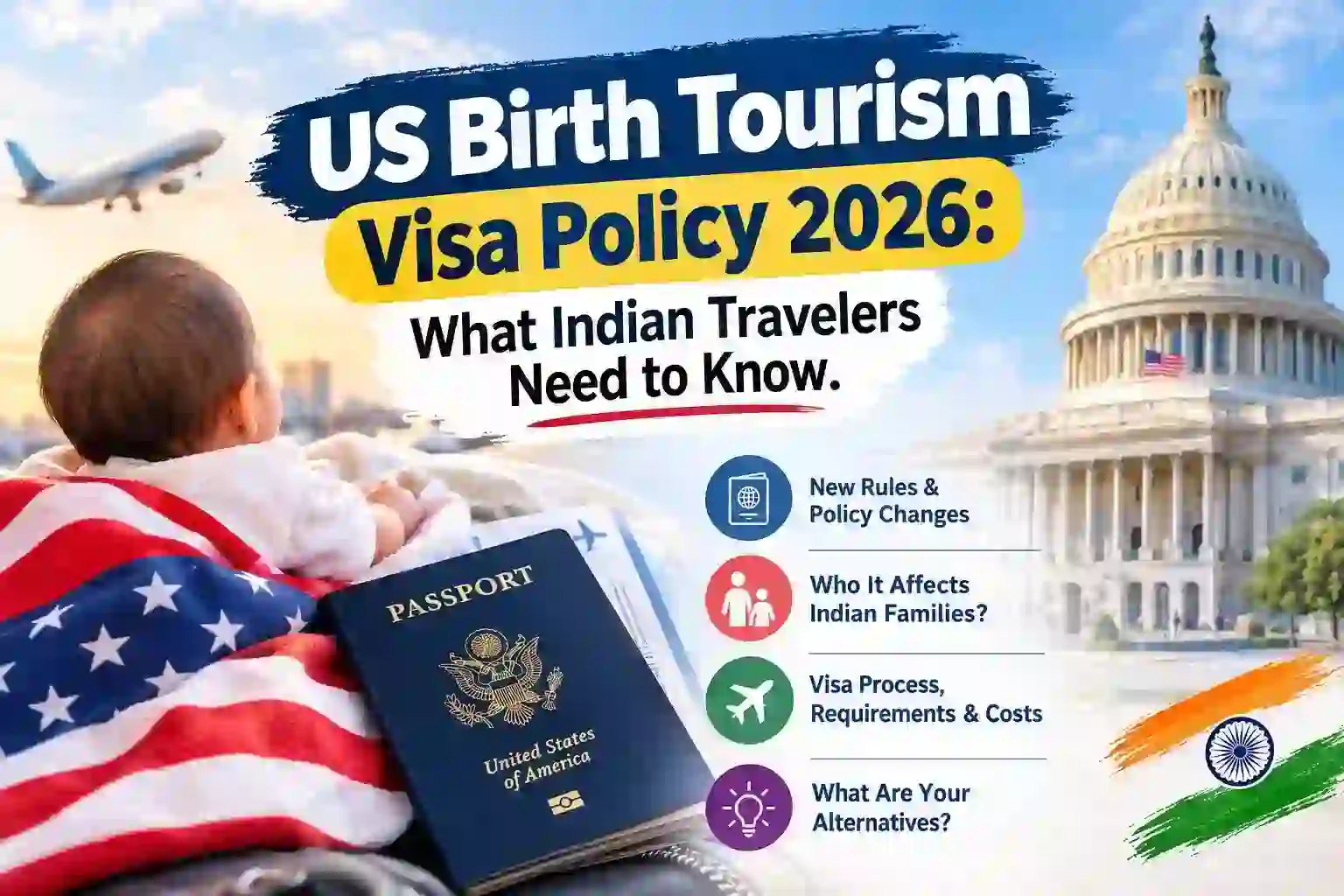
US Birth Tourism Visa Policy 2026 is an important issue for Indian travelers considering a trip to the United States during pregnancy. The key distinction is between a permitted B-2 visitor-visa purpose, such as tourism or certain medical treatment, and traveling primarily to give birth in the U.S. to obtain citizenship for a child.
The U.S. Department of State currently states that birth tourism is not a permissible basis for obtaining a visitor visa when the primary purpose of travel is giving birth in the United States to obtain U.S. citizenship for the child.
For Indian travelers, the issue has gained additional attention in 2026 because of new U.S. executive action concerning birth tourism and ongoing litigation over birthright citizenship.
What Is Birth Tourism?
Birth tourism generally refers to traveling to another country while pregnant with the primary purpose of giving birth there and obtaining citizenship or another immigration-related benefit for the child.
In the United States, the U.S. Department of State specifically defines birth tourism for visa purposes as travel primarily intended to give birth in the country so the child can obtain U.S. citizenship. The State Department says this is not a permissible purpose for a visitor visa.
This distinction is important because being pregnant is not itself the same as engaging in birth tourism. The purpose and circumstances of the proposed trip matter when a visa application is assessed.
Is Birth Tourism Allowed on a U.S. B-2 Visa?
No, if the primary purpose of the trip is to give birth in the United States to obtain U.S. citizenship for the child.
The State Department’s current visitor-visa guidance expressly lists birth tourism as an impermissible use of a visitor visa. B-2 visas otherwise cover activities such as tourism, vacations, visiting family or friends, and certain medical treatment.
The specific B-visa rule addressing birth tourism was introduced in January 2020, meaning the basic restriction is not new to 2026.
Official source: U.S. Department of State – Visitor Visa
What Is a B-2 Visa Used For?
A B-2 visitor visa can generally be used for temporary activities such as:
- Tourism and vacations
- Visiting relatives or friends
- Certain medical treatment
- Social events
- Certain amateur recreational activities
- Short recreational courses that do not provide academic credit
The State Department separately identifies birth tourism as an activity that is not permissible on a visitor visa.
Does Pregnancy Automatically Mean a U.S. Visa Will Be Refused?
No. Pregnancy by itself is not stated by the State Department as an automatic ground for refusing a B-2 visa.
The important issue is the purpose of travel.
For example, a traveler who is pregnant may have legitimate reasons for visiting the United States, but a trip whose primary purpose is giving birth so that the child obtains U.S. citizenship falls under the State Department’s birth-tourism restriction.
Applicants should provide truthful and complete information about their intended travel. The Department of State also says additional documents may be requested to establish the purpose of the trip, intent to depart the United States and ability to pay travel costs.
Medical Treatment and Birth Tourism Are Not the Same
The B-2 visitor category can cover medical treatment.
However, medical treatment and birth tourism should not automatically be treated as the same thing.
The distinction is particularly important where childbirth is involved. If the primary purpose of travel is to give birth in the United States specifically so that the child obtains U.S. citizenship, the State Department identifies that purpose as birth tourism and says it is not permissible on a visitor visa.
Travelers considering medical care in the United States should therefore understand the applicable visa rules and be prepared to explain the genuine purpose of their trip.
What Changed in the U.S. Birth Tourism Policy in 2026?
The basic B-2 restriction on birth tourism did not begin in 2026. The State Department’s specific birth-tourism rule dates to 2020.
What changed in 2026 was the broader policy environment surrounding birth tourism and birthright citizenship.
Three developments are particularly relevant:
- The White House issued Executive Order 14419 on August 6, 2026, titled “Ending Birth Tourism.”
- The administration also issued Executive Order 14418, concerning certain categories of birthright citizenship.
- Federal litigation subsequently resulted in a preliminary injunction against enforcement of the newer birthright-citizenship order for the class covered by the case.
What Is the 2026 U.S. Birth Tourism Executive Order?
On August 6, 2026, the White House issued Executive Order 14419, “Ending Birth Tourism.”
The order defines birth tourism as the entry of a foreign national into the United States on a nonimmigrant visa for the purpose of giving birth on U.S. soil, as well as efforts to facilitate such entry. It directs the Secretaries of State and Homeland Security to update rules, policies and guidance as necessary to implement the order.
The order also says that actions may include measures concerning visa issuance, travel authorization, entry, removal and action against people or organizations that facilitate birth tourism, subject to applicable law. It provides for possible exemptions on humanitarian or national-interest grounds.
Important distinction
Executive Order 14419 is not the document that originally created the B-2 birth-tourism restriction.
The State Department’s visitor-visa guidance already stated that birth tourism was not permissible on a visitor visa when the primary purpose was obtaining citizenship for the child.
The 2026 executive order represents a broader administration policy concerning birth tourism and directs federal agencies to take additional implementation steps.
Read the official order: White House – Executive Order 14419: Ending Birth Tourism
What Is the Status of U.S. Birthright Citizenship in 2026?
Birth tourism policy is closely connected to the separate legal debate over birthright citizenship.
On June 30, 2026, the U.S. Supreme Court issued its decision in Trump v. Barbara. The administration subsequently issued Executive Order 14418 on August 6, 2026, addressing certain categories of children and the administration’s interpretation of the Supreme Court’s ruling.
Executive Order 14418 identifies several categories involving parents who are foreign government employees, certain “alien enemies,” or circumstances involving commercial transactions or alleged fraud connected with obtaining birthright citizenship.
This area remains subject to litigation, so travelers should distinguish between existing visa rules, executive orders, and court orders affecting enforcement.
What Happened in September 2026?
On September 2, 2026, U.S. District Judge Deborah Boardman issued a preliminary injunction blocking enforcement of the administration’s newer birthright-citizenship order for the class covered by the litigation.
Reuters reported that the administration argued the challenge was premature because detailed implementation guidance had not yet been issued. The judge nevertheless granted the preliminary injunction, citing the Supreme Court’s ruling in Barbara.
The Associated Press likewise reported that the injunction would remain in effect while the class-action litigation proceeds.
This means the legal status of birthright citizenship restrictions remains subject to court proceedings. The injunction should not be described as a final resolution of every issue surrounding the executive orders.
Read the latest court coverage:
Reuters – U.S. judge blocks Trump’s newest order limiting birthright citizenship
What Does the U.S. Birth Tourism Policy Mean for Indian Travelers?
For Indian travelers, the practical issue is the actual purpose of the proposed U.S. trip.
An Indian traveler applying for a visitor visa should be prepared to accurately explain:
- Why they are traveling to the United States
- How long they intend to stay
- Where they plan to stay
- Who will pay for the trip
- Whether they have family or other connections in the United States
- Their plans to leave the United States after the temporary visit
- Any medical circumstances relevant to the trip
The U.S. State Department says visa applicants may be asked for additional documentation concerning the purpose of the trip, intent to depart and ability to pay travel expenses.
Applicants should also remember that a visa does not by itself guarantee admission to the United States; admission is determined at the port of entry.
Can an Indian Traveler Visit the U.S. During Pregnancy?
Pregnancy alone should not be presented as an automatic visa ban.
The relevant question is whether the traveler’s stated purpose and circumstances are consistent with the visitor visa category.
The State Department specifically prohibits using a visitor visa when the primary purpose is birth tourism.
Therefore, Indian travelers who are pregnant and considering U.S. travel should be particularly careful to provide accurate information and should not misrepresent the purpose of their trip.
What Should Indian Travelers Do Before Applying for a U.S. Visa?
1. Understand the purpose of the B-2 visa
Review the official State Department visitor-visa guidance before applying.
U.S. Department of State – Visitor Visa Information
2. Be truthful in the DS-160 application
The DS-160 is the online nonimmigrant visa application used for many U.S. visa categories.
Applicants should make sure that information in the application accurately reflects their circumstances and intended travel.
U.S. Department of State – DS-160 Online Nonimmigrant Visa Application
3. Be prepared to explain the trip
Applicants may need to demonstrate the purpose of travel, their intention to leave the United States after the temporary visit and their ability to cover travel expenses.
4. Check the latest U.S. Embassy guidance
Visa procedures and appointment arrangements can change. Applicants should check the U.S. Embassy or Consulate serving their place of residence before submitting an application.
U.S. Department of State – U.S. Visas Portal
What Indian Travelers Should Know About the 2026 Policy
| Question | Current position |
|---|---|
| Is birth tourism allowed on a B-2 visitor visa? | No, when the primary purpose is giving birth in the U.S. to obtain citizenship for the child. |
| Is this restriction new in 2026? | No. The specific B-visa birth-tourism rule dates to January 2020. |
| Does pregnancy automatically mean a visa will be refused? | Pregnancy itself is not identified as an automatic refusal ground in the State Department’s visitor-visa guidance. |
| Can B-2 visas be used for medical treatment? | Yes, medical treatment is listed as a permissible B-2 purpose, subject to the applicable requirements. |
| What happened on August 6, 2026? | Executive Order 14419, “Ending Birth Tourism,” was issued. |
| What happened to the separate birthright-citizenship order? | A federal judge issued a preliminary injunction on September 2, 2026, affecting enforcement for the class covered by the litigation. |
| Is the legal situation settled? | No. Litigation concerning the 2026 executive actions remains ongoing. |
U.S. Birth Tourism Visa Policy 2026: Key Takeaways
- Birth tourism is not a permissible purpose for a U.S. visitor visa when the primary purpose is giving birth to obtain U.S. citizenship for the child.
- The specific B-visa birth-tourism restriction dates to 2020, rather than beginning in 2026.
- Pregnancy itself should not be described as an automatic visa refusal.
- A B-2 visa can be used for certain medical treatment, but that is different from traveling primarily for birth tourism.
- Executive Order 14419 was issued on August 6, 2026, directing federal agencies to take additional action concerning birth tourism.
- The separate legal issue of birthright citizenship remains subject to litigation.
- A September 2026 preliminary injunction affects enforcement of the newer birthright-citizenship order for the class covered by the case.
- Indian travelers should rely on current U.S. government guidance and provide complete and truthful information in visa applications.
Frequently Asked Questions
Is birth tourism legal on a U.S. B-2 visa?
The U.S. Department of State says birth tourism is not a permissible basis for issuance of a visitor visa when the primary purpose is giving birth in the United States to obtain citizenship for the child.
Is the U.S. birth tourism visa policy new in 2026?
No. The specific visitor-visa rule concerning birth tourism was introduced in January 2020. The significant development in 2026 was the issuance of Executive Order 14419 and related executive and legal actions.
Can a pregnant Indian woman apply for a U.S. visitor visa?
Pregnancy alone is not identified by the State Department as an automatic bar to a visitor visa. However, birth tourism-where the primary purpose is giving birth to obtain U.S. citizenship for the child-is not a permissible B-2 purpose.
Can a B-2 visa be used for medical treatment?
Yes. The State Department lists medical treatment among the permissible activities under the B-2 visitor category, subject to applicable visa requirements.
What is Executive Order 14419?
Executive Order 14419, issued August 6, 2026, is titled “Ending Birth Tourism.” It defines birth tourism and directs the Secretaries of State and Homeland Security to take steps to implement the administration’s policy against it.
Did the Supreme Court decide the birthright-citizenship issue in 2026?
The Supreme Court issued a decision in Trump v. Barbara on June 30, 2026. The administration subsequently issued Executive Order 14418 addressing certain categories of birthright citizenship.
Is the birthright-citizenship policy currently settled?
No. A federal judge issued a preliminary injunction in September 2026 affecting enforcement of the newer executive order for the class covered by the litigation. The broader legal proceedings remain ongoing.
Where should Indian travelers check for official information?
The U.S. Department of State’s official visa portal and the relevant U.S. Embassy or Consulate are the appropriate sources for current visa procedures and requirements.
U.S. Department of State – U.S. Visas
Important Note for Readers
U.S. immigration and visa rules can change through regulations, agency guidance, executive actions and court decisions. The information in this article reflects the policy developments and publicly available information referenced above as of September 27, 2026.
Readers should verify current requirements with the U.S. Department of State and the relevant U.S. Embassy or Consulate before making travel or visa decisions.