Economy
US 100% Tariff Threat on India and China: What Trump’s New Russia Sanctions Law Means

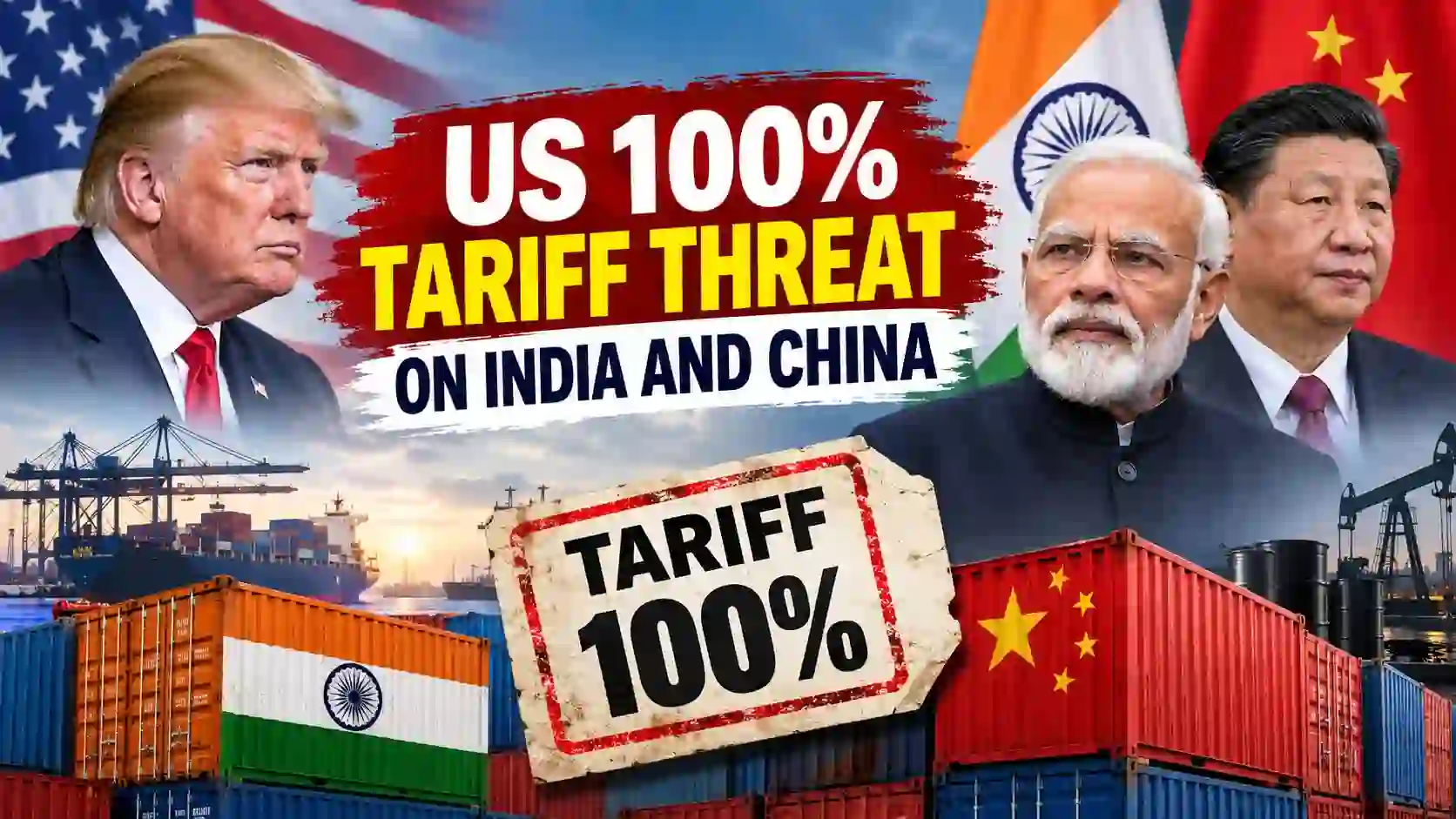
The US 100 percent tariff on India and China has emerged as a major international trade concern after U.S. President Donald Trump signed a new Russia sanctions law that gives the administration expanded authority to impose steep tariffs on countries continuing to purchase Russian oil and gas.
However, the measure does not mean that a blanket 100% tariff on all Indian and Chinese goods has already taken effect. The law creates a legal mechanism for tariffs of up to 100% under specified conditions, potentially affecting major Russian energy buyers including India and China.
Trump Signs Russia Sanctions Law
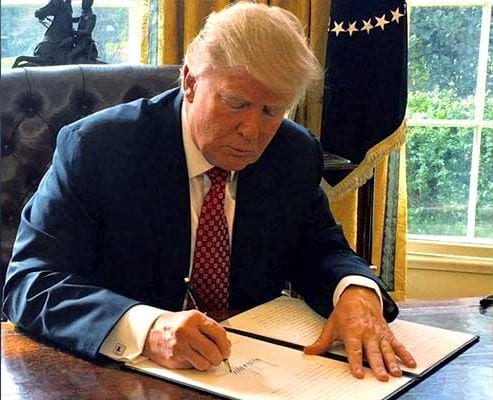
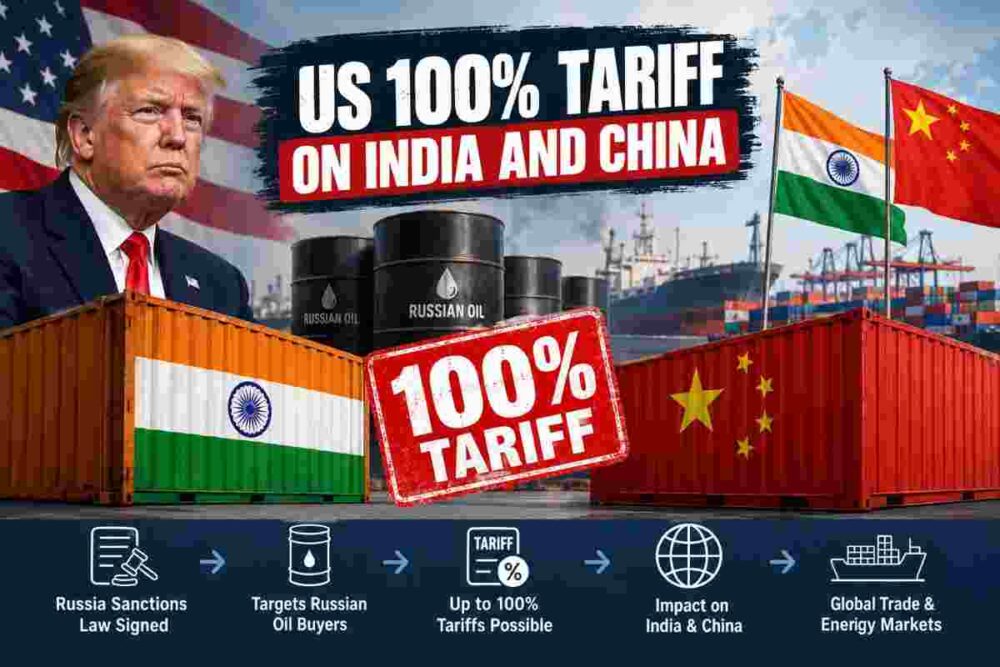
On September 18, 2026, President Trump signed the Lindsey O. Graham Sanctioning Russia and Iran Act of 2026 into law. The legislation expands sanctions against Russia and provides authority for additional tariffs on countries that continue significant purchases of Russian oil and gas.
According to reports, the law could require tariffs of up to 100% on goods imported into the United States from countries covered by its Russian energy provisions. India and China are among the countries potentially affected because of their substantial purchases of Russian crude.
Why India and China Are Being Targeted?
The issue is closely connected to the ongoing Russia-Ukraine conflict and Western efforts to reduce Russia’s energy revenues.
India has remained one of the world’s major buyers of Russian crude oil. New Delhi has argued that maintaining diversified energy supplies is important for the country’s energy security.
China is also a major buyer of Russian energy and therefore falls within the broader group of countries that could potentially face additional U.S. trade measures under the new law.
The legislation is designed to put economic pressure on countries that continue purchasing Russian energy while the United States seeks to restrict revenue flows to Moscow.
India Responds to the US Tariff Threat
India has expressed concern about the potential impact of the new U.S. measures on bilateral relations and international energy markets.
India’s Ministry of External Affairs said that New Delhi remains committed to ensuring energy security for its population and would take necessary measures to protect its trade and economic interests.
The government has also indicated that it will work with Indian trade and industry bodies to assess and respond to the possible consequences.
What Could a 100% Tariff Mean for Indian Exports?
If a 100% tariff were ultimately applied broadly to Indian goods covered by the measure, the consequences could be significant for exporters.
A tariff is generally paid by the importer in the destination country. A very high tariff can therefore increase the landed cost of imported products and potentially affect demand, margins and competitiveness.
Indian industries with significant exposure to the U.S. market could face increased uncertainty. Businesses may need to reassess pricing, supply chains and export destinations if the measures are implemented.
The United States is an important market for Indian exporters. Reuters reported that India’s goods exports to the U.S. reached $42.79 billion during April-August, compared with $40.39 billion during the same period a year earlier.
Impact on the US-India Trade Relationship
The latest development comes after Washington and New Delhi had already been working on a broader trade framework.
In February 2026, the White House announced a U.S.-India trade arrangement under which the United States said it would reduce its reciprocal tariff on India from 25% to 18%, while also removing an additional 25% tariff connected to India’s Russian oil purchases.
The new Russia sanctions law introduces another layer of uncertainty into the trade relationship.
It also demonstrates how energy policy, sanctions and international trade are increasingly interconnected.
Will India Actually Face a 100% Tariff?
This is one of the most important points for businesses and readers to understand.
A 100% tariff should not currently be described as an already-imposed blanket tariff on every Indian product entering the United States.
The new law gives the U.S. administration authority to impose tariffs of up to 100% under specified circumstances involving countries purchasing Russian oil and gas. The actual implementation, scope, affected products and tariff rates will depend on subsequent U.S. government actions.
Therefore, exporters should distinguish between a legal authority to impose tariffs and an already implemented 100% tariff.
What Could Happen Next?
The coming weeks could be important for global trade.
India and the United States may continue diplomatic and trade discussions, while Indian businesses are likely to monitor Washington’s implementation decisions closely.
The situation could also affect global crude oil markets. India has argued that energy security requires access to reliable and affordable supplies from multiple sources. Any major change in the purchasing patterns of large oil-importing countries could have wider implications for international energy markets.
China’s response will also be closely watched because it is another major consumer of Russian energy and a central player in global trade.
Conclusion
The US 100% tariff on India and China is currently best understood as a serious tariff threat and newly expanded U.S. authority rather than a blanket 100% duty that has already been imposed on all goods from both countries.
The development connects three major issues: Russia’s energy trade, U.S. sanctions policy and global commerce.
For India, the challenge is particularly significant because the country must balance energy security and its economic relationship with the United States. For businesses, the immediate priority will be monitoring the details of any future U.S. tariff action and assessing how particular industries and products could be affected.
As Washington decides how to use the powers provided by the new law, the outcome could have implications not only for U.S.-India and U.S.-China trade but also for global energy markets and international supply chains.
Frequently Asked Questions
1. Has the US imposed a 100 percent tariff on India and China?
The US has not imposed a blanket 100 percent tariff on all goods from India and China. The new Russia sanctions law gives the US administration authority to impose tariffs of up to 100 percent under specified conditions involving countries purchasing Russian oil and gas.
2. Why is the US considering a 100 percent tariff on India and China?
The potential tariff is linked to US efforts to put economic pressure on Russia. India and China are major buyers of Russian energy, making their trade with Russia an important part of the US sanctions debate.
3. What could a 100 percent tariff mean for Indian exporters?
A very high US tariff could increase the cost of Indian products entering the American market. Depending on the products affected, exporters could face pressure on pricing, profit margins and competitiveness.
4. Will all Indian products face a 100 percent tariff?
Not necessarily. The tariff authority does not automatically mean that every Indian product will face a 100 percent duty. The products, countries and tariff rates affected would depend on how the US administration implements the law.
5. Why is Russian oil important to India?
Russian crude has become an important source of India’s energy imports. India has maintained that access to reliable and affordable energy supplies is important for its energy security.
6. Could the US tariff affect India-China trade?
The potential measures could have wider implications for global trade if they significantly affect two of the world’s largest economies. Businesses may reassess supply chains, sourcing strategies and export markets depending on how the policy develops.
7. Will the tariff affect Indian consumers?
The direct impact on Indian consumers would depend on the products eventually covered by any US tariff measures. However, changes in export demand, global supply chains and energy markets could have indirect economic effects.
8. What should Indian exporters do now?
Indian exporters should monitor official US trade announcements, review their exposure to the US market and assess alternative markets and supply-chain options. Companies should wait for specific implementation details before assuming that a 100 percent tariff will apply to their products.
9. What is the connection between US tariffs and Russian oil?
The proposed tariff mechanism is connected to US efforts to discourage countries from purchasing Russian oil and other Russian energy products. Tariffs are being considered as an economic tool alongside sanctions.
10. What happens next?
The next major development will depend on how the US administration implements the powers provided by the new sanctions law and how India and China respond. Further trade negotiations and diplomatic discussions could influence the final impact on businesses.