Asia
What is China’s Belt and Road Initiative?

What goes on in China?
While the country may not be cloistered like North Korea, a lot of what goes on inside China, especially its ruling Communist Party, remains a mystery. What is never in doubt is that China has big ambitions, and big money to bankroll those ambitions.
In 2013, this became very apparent when China adopted its now highly contentious and controversial Belt and Road Initiative.
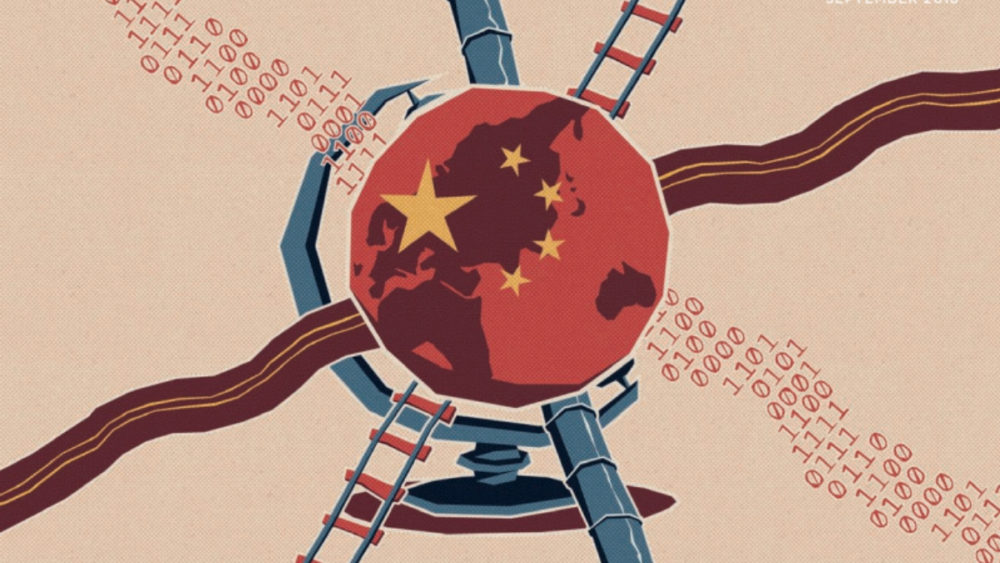
Belt and Road Initiative – China’s Hidden Power Trap?
What is the Belt and Road Initiative?
China has had a very rich history. It is considered a cradle of civilization, alongside Mesopotamia, Indus Valley, and Egypt. At the height of its ancient power, China’s silk road was a gateway between Europe and Asia.
The Communist Party, always big on symbolism, has decided to reestablish China’s position as a premier trading agent through the Belt and Road Initiative. Simply put, the BRI is a set of constructions and investments that China will be undertaking in over 70 countries.
The aim is to create a set of land and sea routes that connect Europe, Asia, and Africa. The project is being touted as perhaps the single biggest infrastructural undertaking in human history, covering 65% of the world’s population and covering more than half of the world’s landmass.
Contrary to what the name indicates, the BRI doesn’t only cover roads and maritime routes. It also includes investments in other infrastructures, notably skyscrapers, dams, ports, and airports.
Written into the Chinese Constitution in 2017, the Belt and Road Initiative is set to be China’s dominant foreign policy till its expected completion in 2049, or the decline of Premier Xi Jinping’s influence, whichever comes first.
As one can imagine, there have been intense debates and discussions around the feasibility and the true aims of the project.
Support for Belt and Road Initiative
Politics aside, over 130 countries have supported China’s BRI project for various reasons. Rich countries such as Singapore have entered for geopolitical strength, while many smaller Asian nations believe that the corridor will help prevent domination of a single power by integrating economies and promoting collective growth.
European nations have also begun to express support for the project as well, and African and Arab nations too, see it as a way of wrenching away from foreign influence and aid, by developing their own infrastructure.
Countries against Belt and Road Initiative
India has been hesitant about the BRI way before the simmering tensions of 2019. And it is not alone in this approach.
USA in particular has challenged China’s BRI as a method of creating a Sino-centric economic system. It worries that with the the BRI, China’s influence will extend way beyond its regional borders, and into countries that would soon become dependent on it for their own economic growth.
Australia and Japan have followed suit, and the three have together started a Blue Dot Network in 2019 to counter the BRI in the Indo-Pacific region.
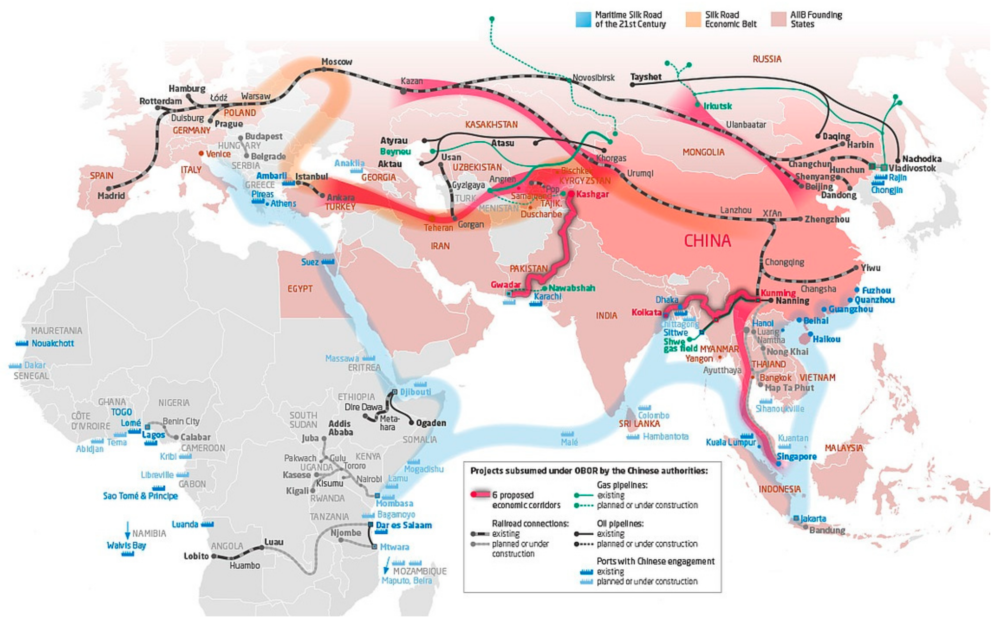
Belt and Road Initiative map
Apart from the politics, there is also the issue of human rights and ecology. The BRI is based on the traditional industrial model, which means cutting of forests for land, and lack of sustainable practices.
Carried out on a wide scale in multiple places across the world, the BRI could spell ecological disaster for countries, especially for coastal regions where building ports and terminals is the top priority, thus not securing the environment against climate change.
The BRI partners did add in an environmental coalition clause in 2019, but it remains to be seen how the countries will balance the need for development with that of environmental issues.
Chinese labor that is sent abroad to work on the BRI is indicated to face gross abuses by the China Labour Watch, including harsh working conditions, confiscation of passports, and highly restricted movement.
Many also believe that the project is a form of neocolonialism, aimed at extending Chinese influence into countries that cannot fight it back because they need the money.
Will the Belt and Road Initiative be successful?
Many countries have mulled about their own competition to the BRI, but China has the favor of a head start, massive funding, and a vast population made pliant by autocratic control.
Western countries and Asian nations such as India can be significant challengers to the BRI, but China seems to have planned the workarounds, and the support of a neighboring country may be all it takes to undermine the opposition.
In the aftermath of the Covid-19 pandemic, fund allocations for foreign infrastructure and influence may be hard to come by when one’s own nation continues to struggle. Interestingly, some scholars are of the opinion that the Belt and Road Initiative is not the offensive move that it is made out to be.
It has long been projected that China’s massive economic development is all set to come to a halt. This is because its infamous one child policy could have the unexpected consequence of creating an aging population, thus leaving fewer young workers and more dependents in its wake.
This demographic crisis will invariably be followed by an economic struggle. Some experts project that China’s demographic crisis is inevitable, and it does not have any other means to maintain the household income, and protect itself from it.
It has thus been suggested that China actually wants to protect its main source of income – trade – by establishing infrastructures in place. As it looks towards automation and seeks to keep its factories running, China wants to ensure that there are supply and export chains in place to aid the process.
With China running out of time – crisis that had not been predicted when the Belt and Road Initiative started in 2013 – it may be possible that BRI might end up fizzling out due to internal factors. However, China has pulled off improbable things before, and it remains to be seen how things will play out.